📌 What Is the Capacity Range of an Automatic Peristaltic Pump Liquid Filling Machine? A Detailed Guide for Industry Needs
When it comes to liquid filling automation, peristaltic pumps are renowned for their accuracy, simplicity, and reliability. However, users like you are often wondering:
"What is the capacity range of an automatic peristaltic pump liquid filling machine?"
In this in-depth guide, we will walk you through the capacity ranges, factors affecting performance, and how to optimize your peristaltic pump system for your specific production needs. Whether you're running a small-scale operation or a high-speed filling line, understanding these capacity ranges and system configurations is essential.
📌 1. What Is the Capacity Range of a Peristaltic Pump Filling Machine?
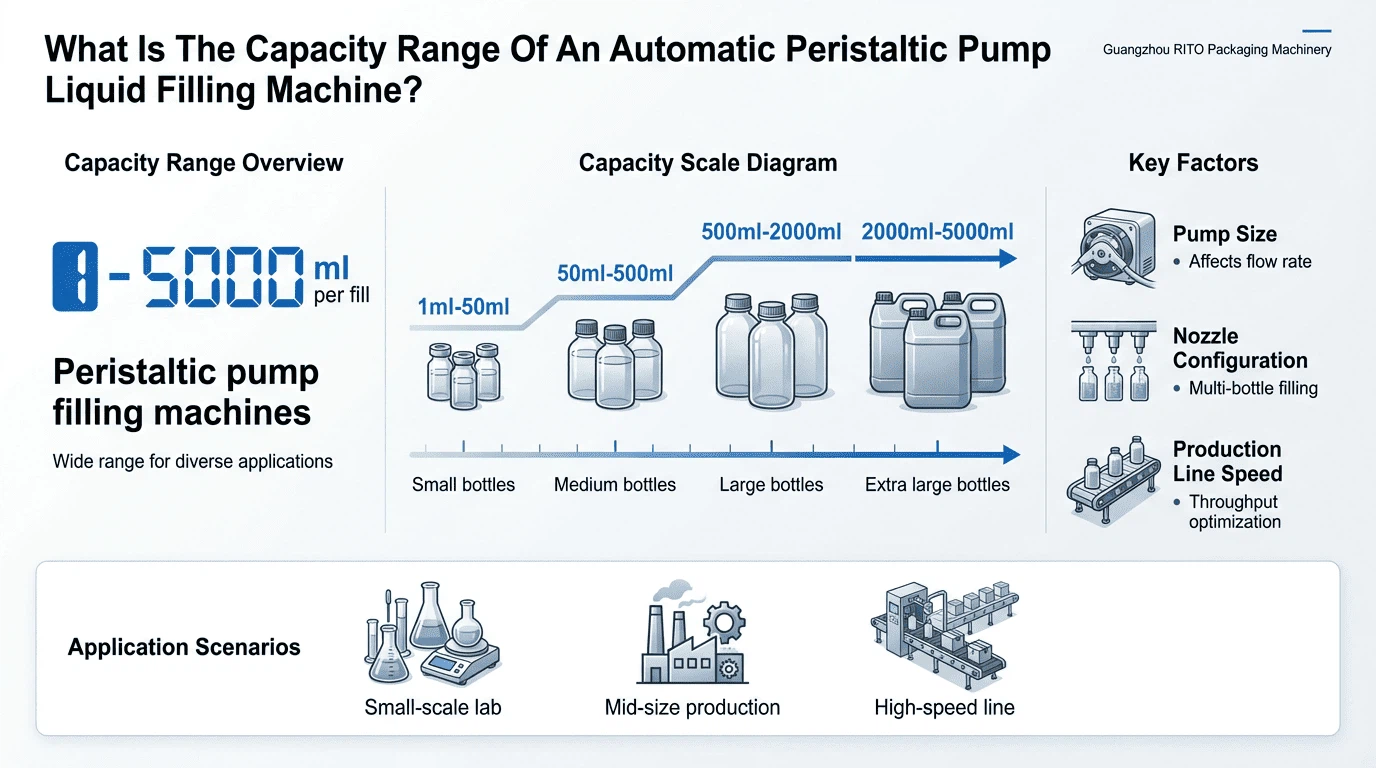
The capacity range of peristaltic pump liquid filling machines varies depending on several factors including container size, liquid properties, automation level, and number of nozzles.
Common capacity ranges for these machines include:
| Capacity Range | Typical Uses | Machine Type |
|---|---|---|
| 50–200 L/h | Small to medium containers | Tabletop, semi-automated, 12-nozzle |
| 200–500 L/h | High-volume filling | Industrial, 20-nozzle configurable |
| 500–1,000 L/h | Very high-speed operations | Fully automated with CIP integration |
This range makes peristaltic pump filling systems versatile, precise, and cost-effective for various industries across different production scales.
📌 2. Understanding the Capacity Variation in Automatic Peristaltic Pump Systems
Peristaltic pump liquid filling machines vary in capacity based on machine type, pump configuration, and fluid conditions. Here's a comparative overview of typical capacity ranges and their significance:
📊 Table: Peristaltic Pump Capacity in Different Applications
| Application | Container Size (Example) | Capacity Range | Typical Filling Volume per Container |
|---|---|---|---|
| Pharmaceutical | 10ml to 1L syringes or vials | 50–500 L/h | Up to 1L |
| Cosmetic | 50ml to 250ml bottles | 50–300 L/h | Up to 200ml |
| Food & Beverage | 100ml to 2L bottles | 100–600 L/h | Up to 2L |
| Industrial and Chemical | 1L to 50L containers | 10–100 L/h | Up to 50L |
| Smallcraft or Lab Use | 1L per batch | 10–150 L/h | Batch filling |
This capacity variation allows users to select the ideal system for their applications, whether precision, speed, or cost is the main concern.
📌 3. How Does Each Component Affect the Capacity of the Machine?
To achieve the best possible capacity, it's important to understand the roles of key components in a peristaltic pump filler:
| Component | Role | Impact on Capacity |
|---|---|---|
| Peristaltic Pump | Provides fluid pumping through tubes | Directly affects flow and speed |
| Servo Motors | Enables precise motor control | Reduces inaccuracy during fill cycles |
| Number of Nozzles | Multi-nozzle systems allow for higher throughput | Can increase capacity to up to 600L/h |
| Control Time & Speed Allocation | Adjusts flow and timing for high accuracy | Synchronizes fill and nozzle behavior |
| Contaminant Control | Prevents cross-contamination through single tube | Enables switching quickly between products |
| PLC & HMI Integration | Enables real-time monitoring and adjustment | Allows maximum efficiency and adaptability |
| CIP Systems | Automates cleaning for hygienic use | Necessary in pharmaceutical and food industries |
📌 4. How to Select the Right Capacity for Your Liquid Filling Needs?
Start with your products:
Are they viscous, sensitive, or stable?
What filling accuracy is required? (e.g., ±0.1%, ±1%, etc.)
Does your process involve regulated standards or high-speed production?
Determine your container sizes:
Small (like 100ml to 200ml cups or bottles)
Medium (like 500ml bottle)
Large (like 5L or 100L drums)
Match your machine with your production speed:
Do you need batch filling or continuous operation?
What is the maximum output per hour you expect? (e.g., 200 bottles/hour)
Consider your maintenance needs:
Are you looking for a low-maintenance system?
Do you use CIP systems to avoid costly downtime?
💡 Insight: For high-speed operations and high accuracy, servo motor and multi-nozzle conjunction is the ideal configuration for a modern liquid filling line.

📌 5. Factors Influencing the Hourly Capacity of a Peristaltic Pump Filling System
Understanding the core components that affect the machine's capacity can help ensure optimal performance.
| Factor | Impact on Capacity | Why It Matters |
|---|---|---|
| Pump Speed | Higher speed = Higher capacity | Directly affects fill volume and time |
| Number of Nozzles | More nozzles = Higher throughput | Enables parallel filling for higher production rates |
| Container Size | Larger containers = Slower cycle | Prevents overfilling and uneven dose distribution |
| Liquid Viscosity | Thicker = Lower capacity | Reduces flow rate, increasing filling time |
| Automation Level | Fully automated = Higher accuracy and speed | Ensures smooth operation across complex setups |
| System Configuration | Conveyor, robots, and PLC control | Determines speed, consistency, and adaptability |
| Liner & Tube Quality | High-quality tubes = Consistent performance | Reduces helical resistance and flow variability |
✅ Tip: For high-accuracy and hygienic operations, a peristaltic pump with single-tube design is a top choice in pharmaceutical and cosmetic applications.
📌 6. Common Applications and Use Cases for Different Capacity Ranges
Peristaltic pumps are used in a wide range of industries, depending on their capacity and precision. Here's a table of real-world use cases and capacity ranges:
| Industry | Typical Filling Range (L/h) | Capacity Use Cases |
|---|---|---|
| Pharmaceutical | 100–200 L/h | Filling syrups, creams, or suspensions |
| Cosmetic | 50–300 L/h | Filling lotions, serums, and gels |
| Food & Beverage | 100–600 L/h | Filling sauces, syrups, or bottled beverages |
| Chemical & Industrial | 20–100 L/h | Filling oils, paints, and solvents |
| Lab / R&D | 20–150 L/h | Small-throughput, batch filling options |
🔧 Therapy Insight: For hygiene-critical or regulated environments, small to medium capacity is closer to industrial standards of compliance. For bulk filling, higher capacity and high-flow systems are preferred.
📌 7. How to Maximize the Filling Capacity and Efficiency of Your System
Here are steps to help you reach your maximum production capacity and maintain consistent performance:
Use high-speed servo-based systems to support higher-cycle-rate filling and low-volume accuracy.
Optimize nozzle configuration with 12-20 nozzles for high-demand applications.
Implement PLC-based timing for each filling cycle, ensuring customizable and repeatable fill sequences.
Choose SERVOS for precision control, especially for viscous or shear-sensitive liquids.
Support various flow rates, allowing for adjustments and flexibility across product types.
Integrate CIP systems if your production involves frequent switching or sanitary requirements.
Tailor the system to your specific use case, such as batch filling, line integration, or batch production.
⬆️ Quick Tip: Balance speed and accuracy to avoid overfilling, underfilling, or product damage, especially with viscous or sensitive liquids.
📌 8. Why Choose Guangzhou RITO Packaging Machinery?
Guangzhou RITO Packaging Machinery is a leading manufacturer of peristaltic pump liquid filling systems that offers high-capacity, high-accuracy, and GMP-compliant solutions for various industrial sectors.
| Feature | Description |
|---|---|
| 20 Years of R&D and Industry Integration | We have developed entire filling lines with system-level integration, including filling, capping, and labeling |
| 3,000+ Square Meters Production Facility | We deliver high-quality, precision-sealed, and durable machines |
| Global Support in Over 40 Countries | From Asia, America, and Europe, our machines are commonly used in pharmaceutical and food industries |
| Top IP Expertise | With IEEE and IEC-60081 standards, we ensure safety compliance and high-performance execution |
| Over 10 Patents (Including Invention Patents) | Our advanced systems support peristaltic pump applications with modular, scalable logic |
| Application-Specific Systems | Whether you need to fill 50ml bottle or 50L drum, our systems can be configured for maximum performance |

📌 Table: Real-World Loading Scenarios Using RITO's Peristaltic Pump Technology
| Application | Container Size | Filling Volume per Bottle | Capacity (L/h) | Machine Type | Auto/Manual |
|---|---|---|---|---|---|
| Medical Syringes | 5–10ml | 200 per minute | 50–200 L/h | Tabletop | Automated |
| Pharmaceutical Bottles | 50ml–500ml | 100 per minute | 100–500 L/h | 12 Nozzle | Semi-Auto |
| Cosmetic Bottles | 100ml–800ml | 50 per minute | 100–300 L/h | Semi-Auto | Fully-Auto |
| Food Products | 200ml–1L | 20–40 per minute | 200–600 L/h | Auto/Manual | Fully-Auto |
| Industrial Liquids | 1L–50L | 10–30 per minute | 50–200 L/h | Auto/Manual | Fully-Auto |
💡 RITO Insight: We support customized capacity settings for your specific use cases, from bench-scale applications to high-speed industrial filling.
📌 9. Real-World Examples of Peristaltic Pump Filling Capacity
Here's how different industries use peristaltic pump filling machines depending on their capacity needs and production goals:
| Industry | Target Products | Capacity Range (L/h) | Why RITO? |
|---|---|---|---|
| Pharmaceutical | syrups, creams, injections | 150–300 L/h | GMP compliance, high accuracy, hygienic design |
| Cosmetics | lotions, serums, gels | 200–500 L/h | Easy switch between products, low contamination risk, adjustable timing |
| Food & Beverage | syrups, sauces, beverages | 500–700 L/h | Modular setup, SCADA integration, easy maintenance |
| Industrial | adhesives, lubricants, inks | 50–200 L/h | Robust and scalable, compatible with various liquids, cost-effective |
✅ RITO Solution: Our peristaltic system is tailored to your needs, whether you're using 12, 20, 30 nozzles or batch filling setups.
📌 10. Final Tips: Choosing the Right Capacity for Your Filling Process
Here are key points to consider when choosing the right capacity for your peristaltic pump filling machine:
| Factor | Recommendation |
|---|---|
| Product | Decide on liquid viscosity and filling accuracy |
| Volume | Use small or large capacity based on bottle size and production speed |
| Nozzle Count | Choose 12 or 20 nozzles for scaling production |
| System Control | Use PLC or HMI for automation, adjustability, and visual diagnostics |
| Maintenance | Ensure easy cleaning with CIP if product switching is frequent |
| Cost | Balance speed and accuracy to match your budget and production goals |