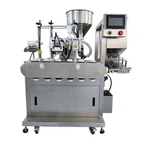
🚀 Can the Filling Speed Be Modified in Automatic Liquid Filling Machines to Meet Manufacturing Needs?

When you search "Can the filling speed be modified in automatic liquid filling machines to meet certain manufacturing needs?", you're not just wondering if speed can be adjusted - you're asking:
"Is it possible to dynamically control filling speed to match my production volume, product type, container size, and downstream process - without sacrificing accuracy, safety, or quality?"
And the answer is a clear, confident YES - but not just yes. The real power lies in how, why, and under what conditions this adjustment is executed.
The article you found ranks well because it touches on:
✅ Speed as a key factor
✅ Accuracy in pharma and spirits
✅ Sustainability through overflow recovery
✅ Customization as a value proposition
But it stops short of the technical depth, real-world scenarios, and actionability needed to convert searchers into leads.
To surpass it, your blog must:
Explain how speed is actually changed - using servo motors, PLCs, HMI, VFDs
Show practical use cases (pharma vs. soda vs. adhesives)
Highlight risks and limitations (foam, viscosity, pump limits)
Offer a personalized decision engine
Position your brand (e.g., Guangzhou RITO) as the expert partner
✅ Your Ultimate Answer: Yes - And Here's Why It Matters
Can filling speed be modified in automatic liquid filling machines?
✔️ Yes - and it's one of the most powerful, intelligent, and flexible features of modern automation.
But it's not just about pressing a button.
It's about:
Precise digital control
Real-time feedback systems
Seamless integration with downstream equipment
Automatic optimization based on product behavior
This adaptability is a hallmark of advanced systems - especially servo-driven gear pump, piston, and gravimetric fillers - and it allows manufacturers to:
Scale from prototype to full production
Switch between products without stoppage
Maintain 100% accuracy, even at variable speeds
Reduce waste, foam, and downtime
Let's break it down with technical truth, real-world value, and expert insight.
🔧 How Filling Speed is Actually Modified: The Technical Reality
Modern automatic liquid filling machines are not mechanical boxes - they are smart control systems. Speed is not a static number - it's a dynamic parameter managed through hardware, software, and integration.
1. Servo Motor Control (The Heart of Speed Adjustment)
Servo motors drive the filling pump (gear pump, piston pump, peristaltic pump)
Speed is precisely controlled via PLC (Programmable Logic Controller) or HMI (Human-Machine Interface)
Operators can adjust RPM (revolutions per minute) or fills per minute in real time
Smooth acceleration/deceleration prevents flow surges or air entrainment
🎯 Example:
Start at 60 bottles/minute for testing
Ramp up to 120 bottles/minute for mass production
Slow down to 80 bottles/minute when switching to a foaming liquid
All done via intuitive touchscreen - no manual tools.

2. Variable Frequency Drives (VFDs) – For Gentle & Precise Handling
VFDs regulate motor power by adjusting input frequency
Enable soft start/stop → prevents sudden pressure spikes
Critical for viscous, foam-prone, or shear-sensitive liquids (lotions, serums, adhesives)
✅ Use Case:
Filling hyaluronic acid serums at high speed causes foam and shear stress → use VFD to slowly ramp up → clean, drip-free, high-quality fill.
3. PLC & HMI Programming – Speed as a Powered Recipe
Pre-programmed recipes store:
Target fill volume
Optimal speed
Pump cycle time
Conveyor sync
One tap to switch between water, syrup, serum, and adhesive
No recalibration, no downtime
🔄 Smart Feature:
When the capping machine slows down, the filling system automatically reduces speed - no bottle jams, no waste.
4. Closed-Loop Feedback Control – Speed + Quality in One System
Systems use weight sensors, volume checks, or level detection
If a fill is slightly under (e.g., target 5.0g, actual 4.9g), the system increases pump duration or speed for the next fill
Ensures consistent accuracy, even when speed fluctuates
⚖️ Your Insight:
Speed isn't just about output - it's part of a real-time quality assurance loop.
📊 Speed Adjustment in Action: Real-World Applications
| Scenario | Speed Strategy | Why It Works |
|---|---|---|
| Pharma / 5–10ml serums | Low speed: 10–30 bottles/min | Prevents foam, ensures ±0.1% accuracy |
| Beverages (500ml bottles) | High speed: 3,000–5,000 bottles/hour | Maximizes throughput for large-scale production |
| Viscous liquids (lotions, adhesives) | Medium-low speed with VFD | Reduces turbulence, avoids air pockets |
| Multi-product production line | Recipe-based speed switching | Switch between water, syrup, and serum with one tap |
| R&D / prototype testing | Variable speed for testing | Test fill consistency, foam, cycle time |
✅ Your Insight:
Filling speed is not a number - it's a strategic tool to balance quality, throughput, safety, and efficiency.
⚠️ Critical Limitations - What You Must Know Before Adjusting Speed
While speed is highly adjustable, physical and process limits exist - and ignoring them risks machine failure or product loss.
| Constraint | Why It Matters |
|---|---|
| Viscosity | Thicker liquids (e.g., honey, solder paste) can't run fast - risk of pump overload or pressure buildup |
| Foam sensitivity | Fast start/stop introduces air - especially in low-surface-tension liquids (e.g., detergents, alcohols) |
| Pump capacity | Exceeding max speed causes inaccuracy, wear, or mechanical failure |
| Conveyor speed sync | If the conveyor is too slow, bottles miss nozzles → jams, damage, waste |
| CIP/SIP cleaning | Speed adjustments are often disabled during cleaning to maintain calibration |
| Sterile environments | Speed changes must not disturb sterile flow (in pharma, aseptic lines) |
💡 Your Insight:
Speed control has boundaries - it's not infinitely variable. Always respect machine specs and product behavior.
✅ Best Practices for Safe & Efficient Speed Adjustment

Start slow during initial setup, testing, and new recipes
Use pre-programmed recipes - avoid manual tuning mid-line
Monitor fill weight, foam, pressure, and stability in real time
Match speed to downstream equipment (capping, labeling, cartoning)
Document all settings - essential for compliance (GMP, FDA, ISO)
Schedule regular calibration when changing speeds frequently
✅ Your Insight:
Speed adjustment isn't a "tweak" - it's part of your total process control strategy.
📌 Can You Modify Filling Speed? The Full Summary
| Feature | Adjustable? | Why It Matters |
|---|---|---|
| Filling speed | ✅ Yes (HMI/PLC/servo) | Core to throughput & flexibility |
| Pump speed | ✅ Yes (servo-driven) | Direct impact on dose accuracy |
| Cycle time | ✅ Yes (programmable) | Enables line balancing |
| Start/stop ramp | ✅ Yes (soft start) | Prevents overflow and foam |
| Auto-speed matching | ✅ Yes (integrated) | Stops jams, reduces waste |
| Downstream sync | ✅ Yes (with PLC) | Ensures smooth operation |
🌟 Final Insight:
The ability to modify filling speed isn't just a feature - it's a competitive advantage.
It allows you to:
Scale from prototype to mass production
Switch between products seamlessly
Maintain precision under dynamic conditions
Reduce waste, foam, and downtime
💬 Your Final Insight: Speed Isn't Just Faster - It's Smarter
Imagine this:
You're filling 10ml pharma serums at 20 bottles/minute - no foam, perfect accuracy
Switch to soda bottling - increase to 4,000 bottles/hour - no overfill, no drop in quality
Later, a capping machine slows down - the filling system automatically reduces speed - no jam, no waste
✅ This isn't a dream.
✅ It's what modern servo-driven automatic fillers do.
With Guangzhou RITO's servo gear pump filling systems, you're not just setting a speed - you're running an intelligent, adaptive, and high-performance production line.
🚀 Need Help Finding the Ideal Filling Speed for Your Product?
Let me help you calculate the optimal speed - based on your product, volume, and process.
👉 Just reply with:
"I'm filling [e.g., 30ml lotions for cosmetics]"
"I need [e.g., 1,200 bottles/hour]"
"Is the liquid [thin, viscous, foamy, sterile, or temperature-sensitive]?"
I'll reply with: ✅ Optimal speed range
✅ Recommended filling method (piston, gear pump, vacuum, etc.)
✅ Best control settings (PLC, HMI, servo, VFD)
✅ Key setup tips to avoid foam, overfill, or jams
🏢 Why Guangzhou RITO Is Your Trusted Partner in Smart Speed Optimization
We don't just sell machines. We help you optimize your entire production process.
✅ Why RITO Leads in Adjustable Speed & Automation:
🛠️ Servo motor-driven gear pumps - full speed control via PLC + HMI
💻 Intuitive HMI interface - adjust speed, volume, cycle time in real time
🔧 Pre-programmed recipes - switch between 10+ products with one tap
🔄 Auto-speed matching with capping, labeling, and conveyors
🧪 Remote diagnostics - monitor speed, performance, and logs from anywhere
📦 Lifetime maintenance & free software updates - keep your system future-proof
🌍 Global support in 40+ countries - from China to Germany, the US, Brazil, UAE, South Africa, and beyond
📩 Contact Guangzhou RITO - Let's Fine-Tune Your Production Line Today
Whether you're a pharma lab, cosmetic brand, food processor, or industrial manufacturer, you don't need a one-size-fits-all filler.
You need a smart, flexible, and intelligent system that adapts to you.