Should You Choose Standard or Corrosion-Resistant Filling Machines for Strong Acid and Alkali Products?
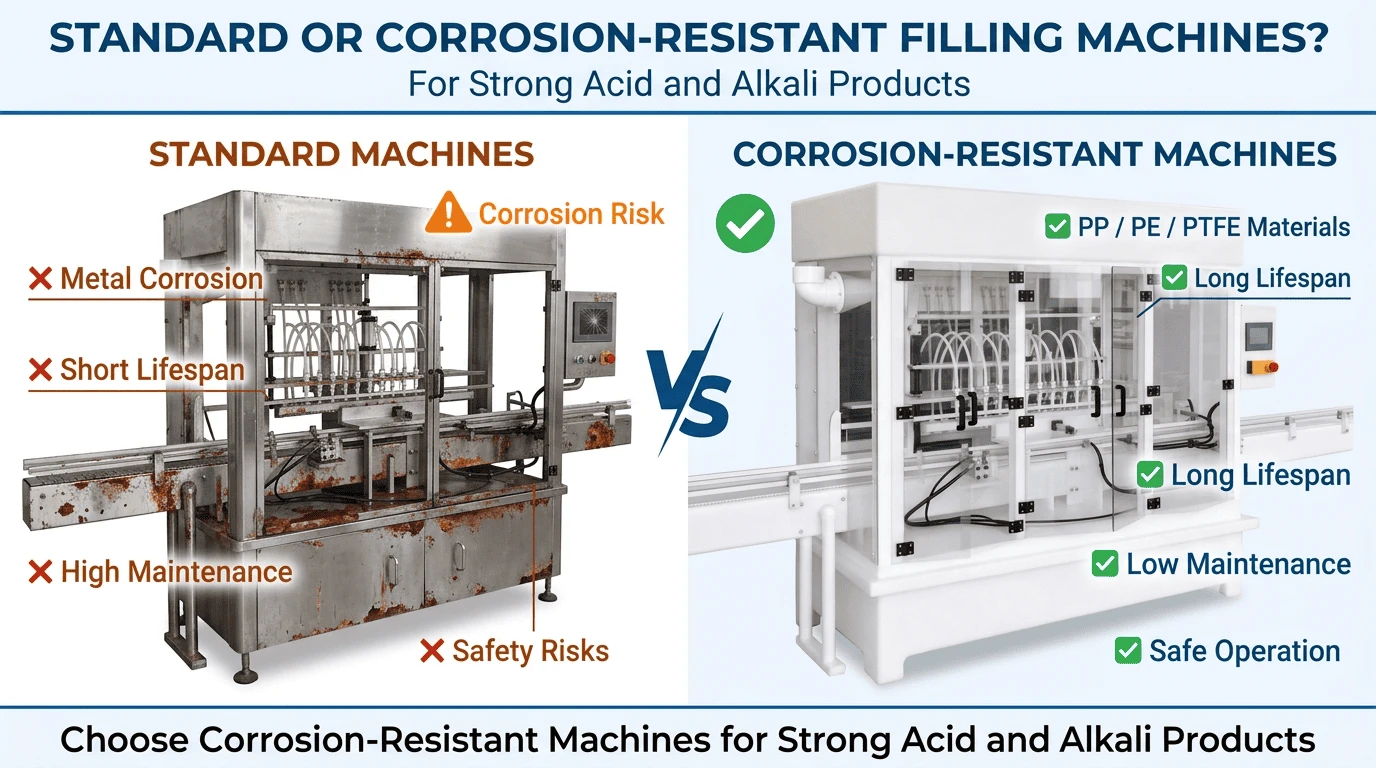
When it comes to strong acid and alkali products, selecting the wrong filling machine can lead to safety hazards, equipment failure, and costly downtime. This comprehensive guide will explore why corrosion-resistant filling machines are the ideal choice, how they differ from standard models, and how Guangzhou RITO Packaging Machinery Co., Ltd. stands out as a leader in delivering safe, precise, and long-lasting chemical filling solutions.
🔍 Table of Contents
1. What Are Strong Acid and Alkali Products?
2. Why Standard Filling Machines Are Not Suitable
3. What Is a Corrosion-Resistant Filling Machine?
4. Key Materials Used in Corrosion-Resistant Filling Equipment
5. Types of Corrosion-Resistant Filling Machines (With Applications)
6. Critical Components of Corrosion-Resistant Filling Systems
7. Why Corrosion-Resistant Filling Machines Are Essential
8. Guangzhou RITO: Your Trusted Partner in Corrosion-Resistant Packaging Solutions
9. How to Choose the Right Filling Machine for Your Needs
10. Smart Technology for Safe and Efficient Operations
11. Common Problems and How to Avoid Them
12. Conclusion
1. What Are Strong Acid and Alkali Products?
Strong acids and alkalis are chemical substances that can be highly corrosive to most materials. These include:
Strong acids: Sulfuric acid, hydrochloric acid, nitric acid, etc.
Strong alkalis: Sodium hydroxide, potassium hydroxide, bleach (sodium hypochlorite), etc.
These chemicals are commonly used in chemical manufacturing, water treatment, agrochemicals, cleaning, and industrial coatings. However, due to their aggressive nature, they pose significant corrosion risks to standard equipment, affecting both the efficiency and safety of the filling process.
2. Why Standard Filling Machines Are Not Suitable for Corrosive Chemicals
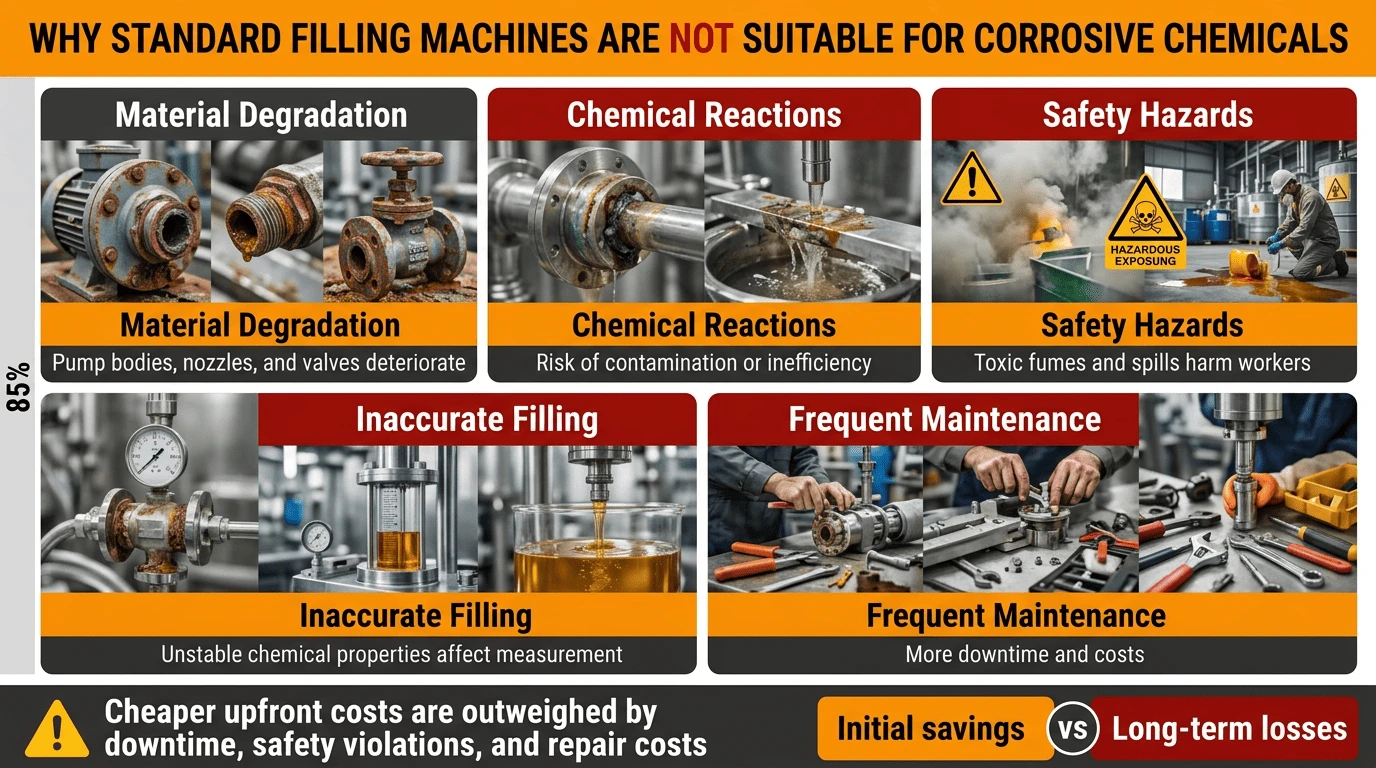
Standard filling machines are typically made of materials like carbon steel or mild steel, which can be swiftly corroded by strong acids and alkalis. This leads to a range of issues:
| Problem | Impact |
|---|---|
| Material degradation | Deterioration of pump bodies, nozzles, and valves |
| Chemical reactions | Risk of contamination or inefficiency |
| Safety hazards | Exposure to toxic fumes or spills can harm workers |
| Inaccurate filling | Unstable chemical properties can affect measuring systems |
| Frequent maintenance | Shorter equipment lifespan leads to more downtime and costs |
Although standard filling machines may be cheaper upfront, the cost of downtime, safety violations, and repairs can far outweigh the initial savings.
3. What Is a Corrosion-Resistant Filling Machine?
Corrosion-resistant filling machines are precision-engineered systems designed specifically for handling aggressive corrosive chemicals such as strong acids and alkalis.
Unlike standard machines, they are built with specialized materials and design features to ensure durability, accuracy, and safety. These include:
High-grade stainless steel 316L
PTFE (Teflon) for sealing and piping
PVDF for high-volume liquid transfer
Stainless steel valves and nozzles
Enclosed filling zones with fume extraction systems
These machines are not just tools - they are essential investments for companies dealing with corrosive and reactive substances.
4. Key Materials Used in Corrosion-Resistant Filling Equipment
Choosing the right material for corrosive chemicals is critical to both equipment longevity and safety. Guangzhou RITO uses a combination of premium and specialized materials to ensure high performance:
| Material | Description | Key Use Case |
|---|---|---|
| Stainless Steel 316L | High resistance to corrosion and chemicals, ideal for handling strong acids and alkalis | Main structural parts, nozzles, and valves |
| PTFE (Polytetrafluoroethylene) | Completely inert to most acids and solvents, excellent for sealants and piping | Nozzle sealing, liquid transfer lines |
| PVDF (Polyvinylidene fluoride) | Chemical-resistant polymer, handles both acidic and alkaline liquids | Liquid containers and internal piping |
| EPDM and Viton Seals | Specialty rubber seals for chemical resistance | Seals, O-rings, and gaskets in the system |
Guangzhou RITO's choice of materials ensures that its machines are safe, durable, and compliant with international chemical handling standards.
5. Types of Corrosion-Resistant Filling Machines (With Applications)
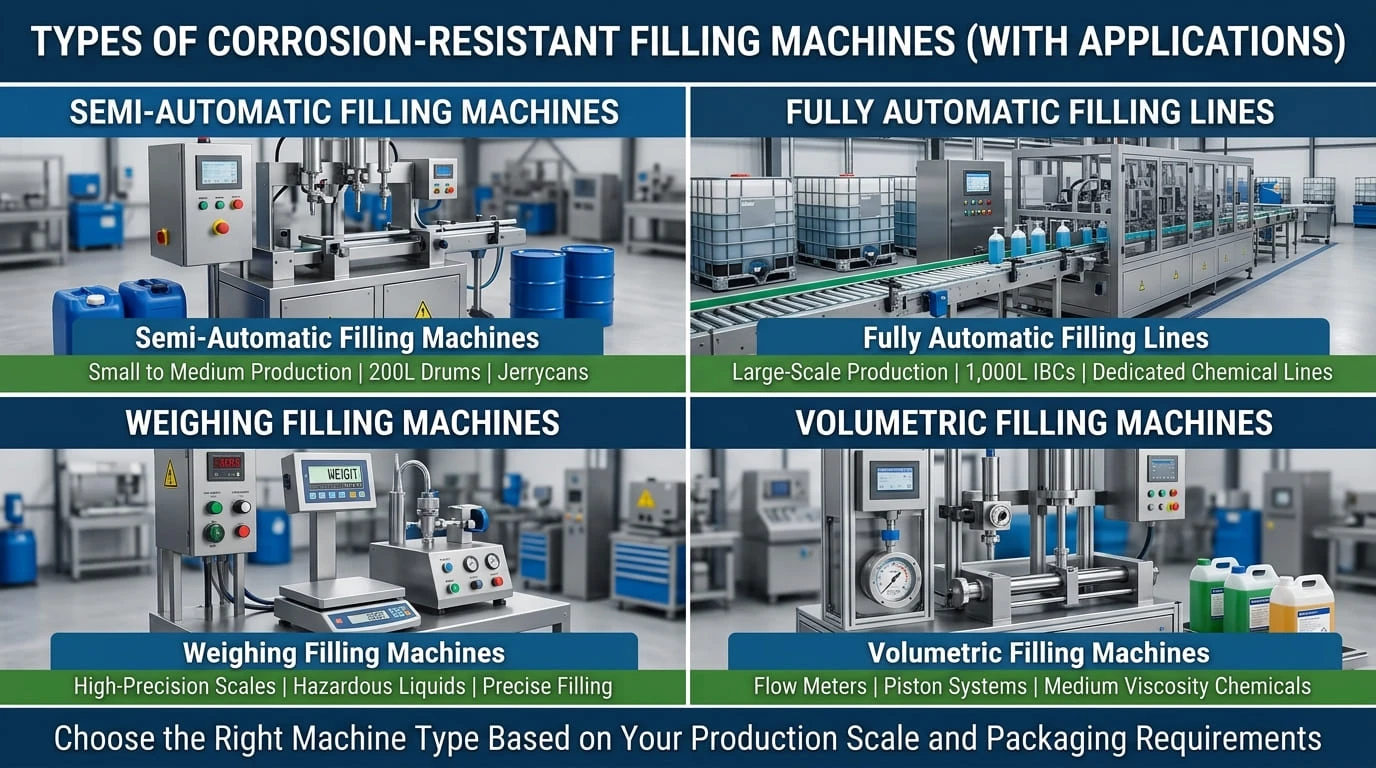
Depending on your production scale and packaging requirements, different types of corrosion-resistant filling systems may be more appropriate:
| Type of Machine | Description | Ideal For |
|---|---|---|
| Semi-Automatic Filling Machines | Requires some manual input, ideal for small to medium production | Small batch filling, 200L drums, jerrycans |
| Fully Automatic Filling Lines | Complete automation, allowing for high-volume, high-precision filling | Large-scale production, 1,000L IBCs, dedicated chemical lines |
| Weighing Filling Machines | Uses high-precision scales to measure weight and adjust flow | Precise filling of hazardous liquids |
| Volumetric Filling Machines | Measures volume via flow meters or piston systems | Medium viscosity chemicals and non-extreme corrosives |
Guangzhou RITO's corrosion-resistant filling solutions are designed to fit any production requirement, from small labs to large chemical factories.
6. Critical Components of Corrosion-Resistant Filling Systems
A well-designed anti-corrosion filling machine includes several key components that work together to ensure safety, precision, and compliance:
| Component | Function | Guangzhou RITO Advantage |
|---|---|---|
| Filling Nozzles | Ensures smooth, leak-free transfer | Specialized anti-splash design, corrosion-resistant materials |
| Weighing Platform | Measured with high-accuracy sensors | Tempered for high chemical resistance and high precision |
| Control System | PLC-based automation for regulation | User-friendly touch screens and real-time monitoring |
| Safety Enclosure | Protects operators from chemical exposure | Tempered and sealed with advanced ventilation systems |
| Conveyor Systems | Automates movement of containers | Customizable for various container types and production speeds |
| Fume Extraction Systems | Removes harmful vapors | Ensures safe and compliant working conditions |
These components work in harmony to ensure safe and accurate chemical filling, and Guangzhou RITO's systems are designed with industry-leading technology.
7. Why Corrosion-Resistant Filling Machines Are Essential
When filling strong acid and alkali products, specialized equipment is not optional - it's essential. Here's why:
| Benefit | Why It Matters |
|---|---|
| Worker Safety | Reduces exposure to harmful fumes and liquids with enclosed systems and ventilation |
| Precision and Accuracy | Ensures consistent filling with weighing or volumetric systems |
| Longevity | High quality materials mean longer equipment lifespan |
| Compliance | Meets international standards like ATEX, CE, and ISO |
| Cost-Effectiveness | Minimizes downtime and repair costs through durable design and smart monitoring |
For businesses that rely on chemical filling for a wide range of industries, an anti-corrosion filling machine is the only viable option.
8. Guangzhou RITO: Your Trusted Partner in Corrosion-Resistant Chemical Packaging
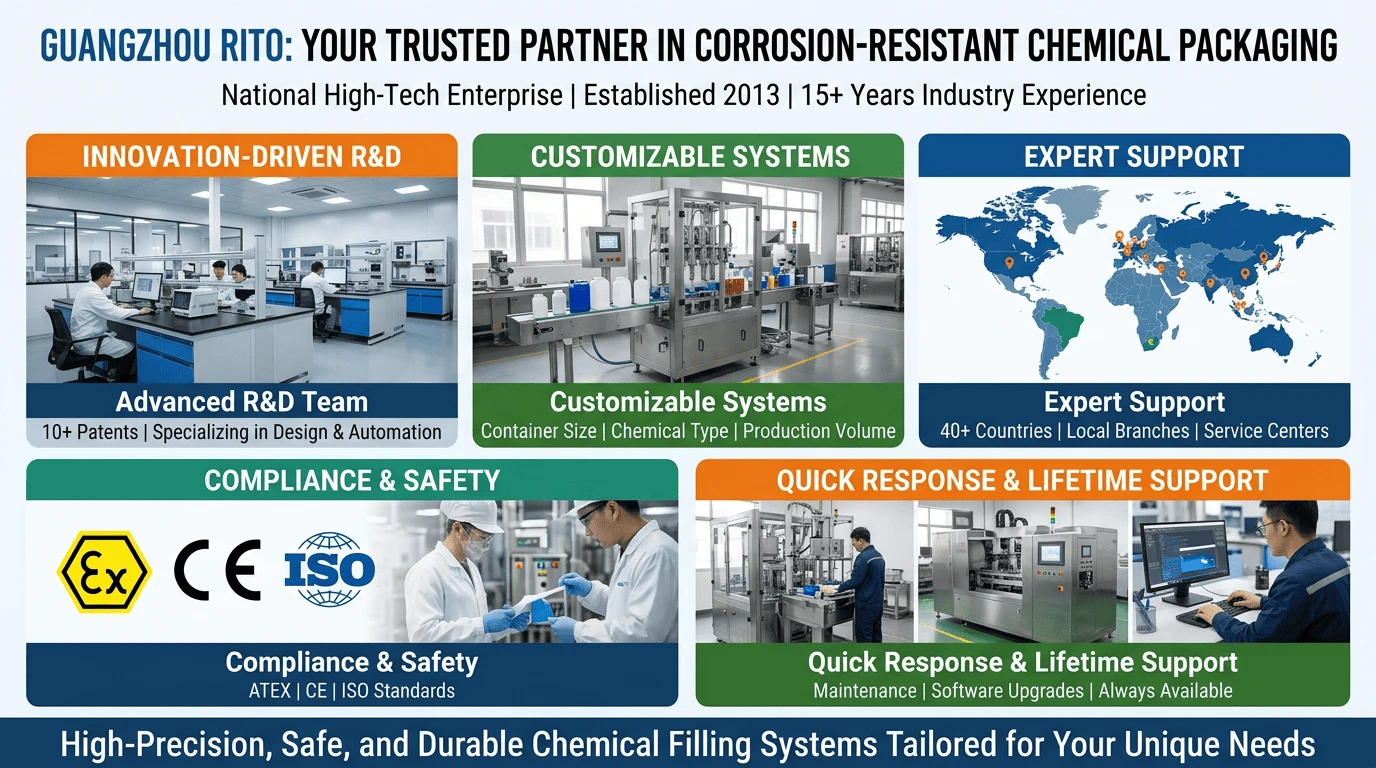
As a national high-tech enterprise established in 2013, Guangzhou RITO Packaging Machinery Co., Ltd. has built a reputation for quality, innovation, and customer-centric support in the field of corrosion-resistant filling equipment.
With our advanced R&D team, strong 10+ patents, and 15 years of industry experience, we provide high-precision, safe, and durable chemical filling systems tailored for your unique needs.
Why Choose RITO?
Innovation-driven R&D with a team specializing in packaging machine design and automation
Customizable systems to fit your container size,Chemicals type, and production volume
Expert support from local branches and service centers within China and over 40 countries
Compliance and safety standards across ATEX, CE, and ISO
Quick response and lifetime maintenance and software upgrades
9. How to Choose the Right Filling Machine for Your Needs
Selecting the right machine comes down to a few key factors:
| Criteria | Considerations |
|---|---|
| Chemical Type | Strong acids/alkalis or mild solvents? |
| Viscosity Level | Does it affect the choice of fill mechanism? |
| Container Size | Smaller jerrycans or large IBCs? |
| Production Volume | Low, medium, or high? |
| Automation Requirements | Semi-automated or fully automated? |
| Safety and Compliance | Achieve international safety standards |
| Budget and ROI | Invest in a machine that offers long-term value |
Guangzhou RITO's corrosion-resistant filling systems are designed with all these factors in mind, offering flexible, reliable, and future-proof solutions for your chemical packaging needs.
10. Smart Technology for Safe and Efficient Operations
Modern corrosion-resistant filling equipment is not just about physical durability - it's also about smart integration. Guangzhou RITO's chemical filling lines incorporate:
PLC control systems for automated operation
Touch-screen interface for easy monitoring and adjustment
Data tracking and error alerts for real-time quality control
Remote diagnostics for quick troubleshooting and maintenance support
Smart sensors for monitoring fill weight, temperature, and viscosity
Integrated capping and labeling modules for complete automation
These smart features help reduce manual labor, improve accuracy, and increase production efficiency - all critical for chemical industries dealing with hazardous materials.
11. Common Problems and How to Avoid Them
Even the best corrosion-resistant filling machines can face challenges. Here's how to avoid them:
| Issue | Solution |
|---|---|
| Foaming liquids | Use bottom-up filling nozzles to minimize splashing |
| Nozzle clogging | Clean system regularly and use compatible materials |
| Spillage | Calibrate weighing sensors and ensure proper system design |
| Corrosion on fittings | Replace worn parts promptly and use non-metallic alternatives |
| Chemical reactions | Ensure material compatibility and neutralization cleaning after each shift |
By following these best practices, you can enhance the performance and longevity of your filling machine while ensuring operator safety.
12. Conclusion
When it comes to strong acid and alkali products, corrosion-resistant filling machines are not just recommended - they're essential for safe, accurate, and sustainable chemical packaging.
Guangzhou RITO Packaging Machinery Co., Ltd. stands out as a leader in the industry due to its:
Innovative R&D and 10+ patents
Customized solutions for a wide range of chemical applications
Industry-leading materials and safety features
Global presence and excellent customer service
Investing in the right filling machine can significantly improve production efficiency, worker safety, and compliance - especially for chemical and industrial applications.
For your safety, accuracy, and long-term business goals, consider Guangzhou RITO as your industry partner in corrosion-resistant packaging solutions.