When It Comes to Anti-Corrosion Filling Machines, Is the Material More Important Than the Coating?
In the world of industrial machinery, especially anti-corrosion filling machines, a common debate arises: "Is the material more important than the coating?"
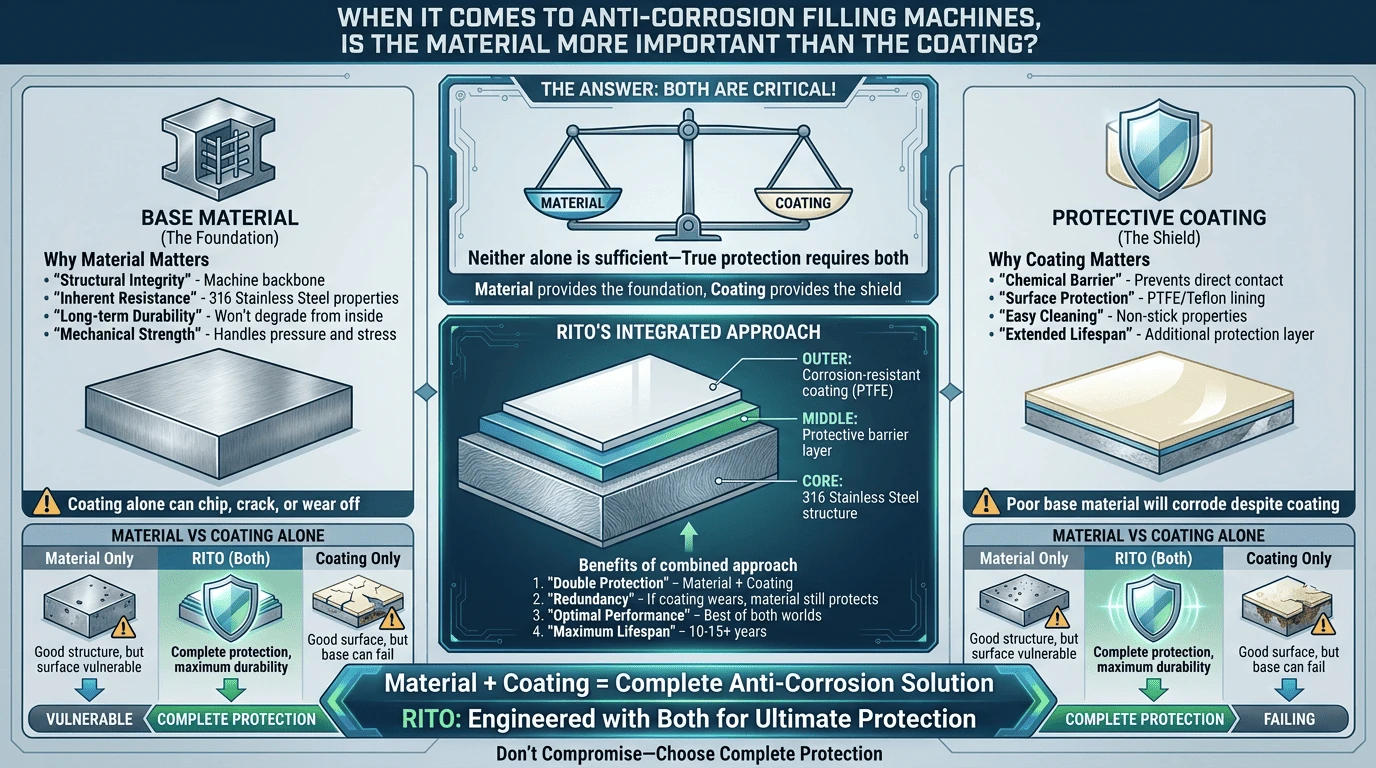
While coatings provide an added layer of protection and enhanced surface resistance, the base material is the foundation of long-term reliability and performance in corrosive environments.
This article will help you understand:
Why the material selection is more critical than the coating in anti-corrosion filling systems
How RITO approaches the selection of materials and coatings for corrosive liquid filling
The types of corrosion and their impact on filling performance
What coating technologies can be used in anti-corrosion filling machines
How to combine material and coating effectively for long-life, safe, and cost-efficient solutions
Why RITO is a better choice for users who want both corrosion resistance and operational reliability
📚 Table of Contents
What Is Anti-Corrosion Filling?
Why Does Material Matter More Than Coating in Corrosive Environments?
Common Corrosion Types That Affect Filling Machines
What Kind of Coating do Anti-Corrosion Filling Machines Use?
RITO's Strategy: Material First, Coating as a Complement
What Materials Does RITO Use in Anti-Corrosion Filling Machines?
How Does RITO Ensure Anti-Corrosion in Production?
Why Choose RITO for Both Material and Coating in Corrosion Resistance?
Can a Coating Alone Guarantee Anti-Corrosion Performance?
Real-World Applications of RITO's Anti-Corrosion Filling Machines
How to Select the Right Material and Coating for Your Filling Needs?
RITO's Anti-Corrosion Filling Machines – A Comprehensive Overview
🧠 1. What Is Anti-Corrosion Filling?
Anti-corrosion filling machines are specialized packaging equipment designed to handle corrosive and highly viscous materials safely.
They are used in chemical, pharmaceutical, and industrial settings where standard machines can be damaged by exposure to acids, solvents, and reactive substances.
While coating plays an important role, it is not sufficient on its own for long-term durability.
🧪 2. Why Does Material Matter More Than Coating in Corrosive Environments?
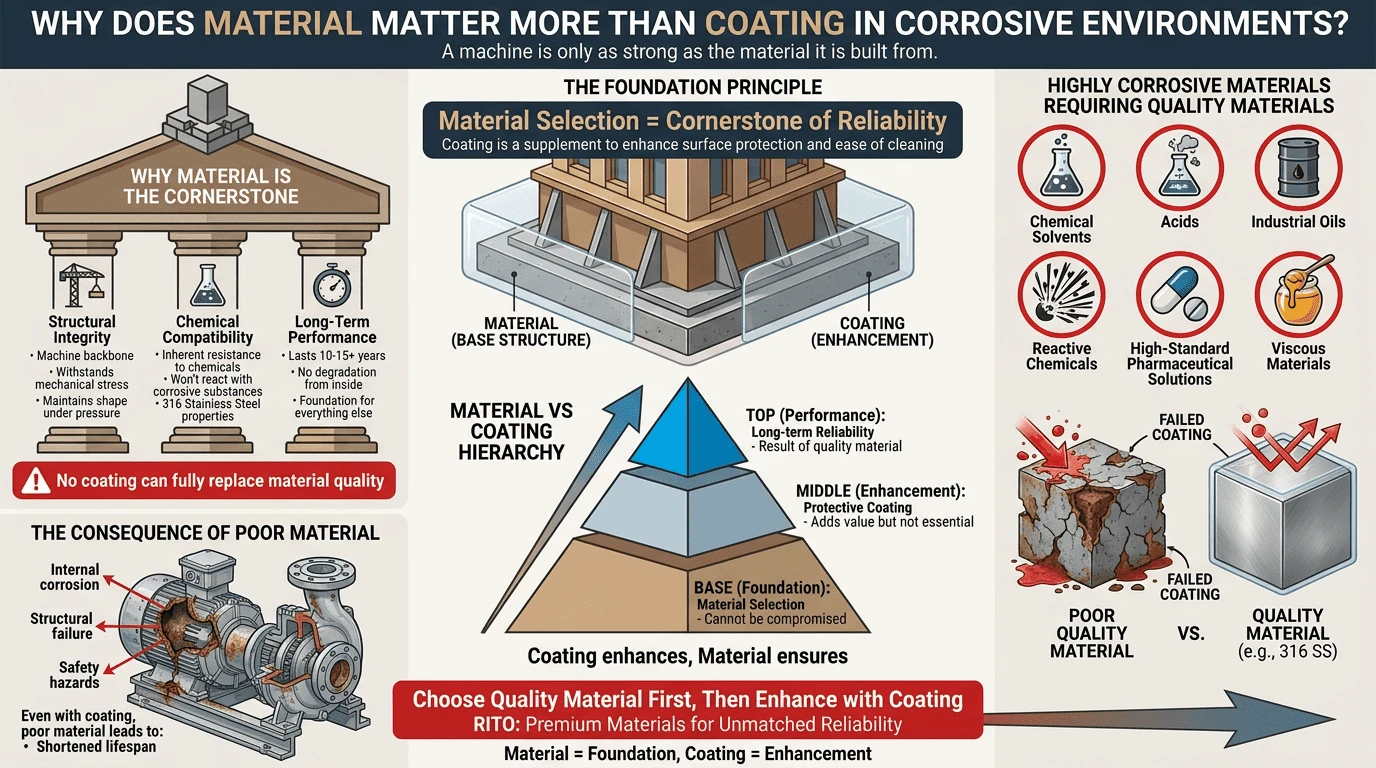
A machine is only as strong as the material it is built from.
In corrosive environments, material selection is the cornerstone of reliability, while coating is a supplement to enhance surface protection and ease of cleaning.
This is especially true for highly corrosive and viscous materials like:
Chemical solvents
Acids
Industrial oils
Reactive chemicals
High-standard pharmaceutical solutions
Material choice ensures structural integrity, chemical compatibility, and long-term performance, which no coating can fully replace.
⚙️ 3. Common Corrosion Types That Affect Filling Machines
There are several types of corrosion that can affect filling equipment and components, depending on the material and environment:
| Corrosion Type | Description | Impact on Filling Machines |
|---|---|---|
| Galvanic Corrosion | Occurs when two different metals are in contact with a conductive medium | Can cause electrochemical damage and degradation of precision parts |
| Stress-Corrosion Cracking (SCC) | A result of mechanical stress and corrosive exposure | Increases the risk of cracks and mechanical failure |
| Crevice Corrosion | Occurs in gaps or crevices where corrosive substances can trap and attack the surface | Leads to deterioration of internal and external parts |
| Intergranular Corrosion | Affects the interfaces between grains | Can weaken the structural stability of the machine |
| Pitting Corrosion | Localized damage causing small pits or holes | May lead to leakage or structural failure |
Understanding these corrosion types helps you choose the most relevant material and coating for your application.
🧾 4. What Kind of Coating do Anti-Corrosion Filling Machines Use?
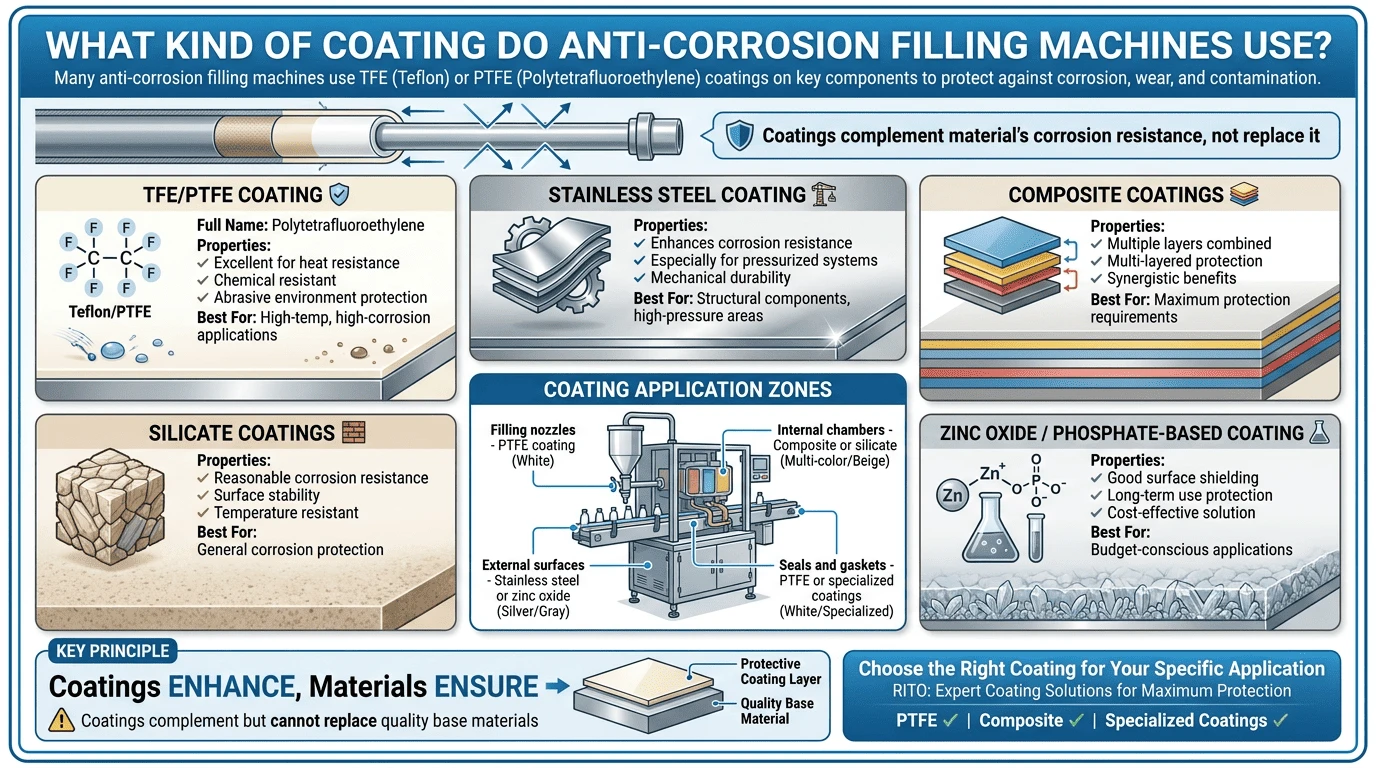
Many anti-corrosion filling machines use TFE (Teflon) or PTFE (Polytetrafluoroethylene) coatings on key components to protect against corrosion, wear, and contamination.
Common coating types include:
TFE/PTFE Coating – Excellent for heat, chemical, and abrasive environments.
Stainless Steel Coating – Enhances corrosion resistance, especially for pressurized systems.
Composite Coatings – Combining multiple layers for multi-layered protection.
Silicate Coatings – Offers reasonable corrosion resistance and surface stability.
Zinc Oxide or Phosphate-Based Coating – Good for surface shielding and long-term use.
These coatings are used to complement the material's corrosion resistance, not replace it.
🏆 5. RITO's Strategy: Material First, Coating as a Complement
At RITO, we believe that while coating is important, the core material is more critical in corrosion-resistant filling systems.
✅ Why Material is the Foundation
High-quality materials, like 316L stainless steel or titanium-based alloys, resist corrosion much better than coating alone
Material choice ensures long-term machine durability, especially in high-acid or high-alkaline environments
✅ Why Coating is Still Used
Coating improves surface performance, reduces chemical contact, and makes cleaning easier
It's a cost-effective and practical solution for lighter corrosion environments and prevents contamination
Result: We start with material and add coating where needed, ensuring both protection and performance.
⚙️ 6. What Materials Does RITO Use in Anti-Corrosion Filling Machines?
At RITO, we use a combination of high-performance materials, including:
| Material Type | Application | Why It Matters for Corrosion |
|---|---|---|
| 316L Stainless Steel | Used in pumps, valves, and mainframe structures | Excellent corrosion resistance in harsh chemical environments. |
| TFE/PTFE Coating | Used for key contact areas | Provides cleaning flexibility and longer part lifespan. |
| High-Temperature Alloys | Used for severe environments | Mineral and chemical resistance under extreme conditions. |
| Zinc-Titanium Composite Materials | Specialized applications | Combines material resistance with coating insights. |
| Custom Material Selection | Tailored for specific industrial needs | Ensures perfect compatibility and performance. |
These selections reflect our scientific approach to anti-corrosion, ensuring both safety and performance.
🔍 7. How Does RITO Ensure Anti-Corrosion in Production?

At RITO, anti-corrosion is engineered at the core of our product design, not just as an afterthought.
🔧 Material Selection Strategy
We select stainless steel and other metal alloys based on the corrosivity of the target material and operating conditions.
Our material engineers ensure that the foundation is reliable and corrosion-proof.
🧼 Coating Strategy
We apply TFE or PTFE coatings to high-contact areas to enhance surface protection.
These coatings are tested for chemical compatibility and durability.
This complementary approach ensures maximum protection while avoiding the limitations of coating dependency.
🧠 8. Why Choose RITO for Both Material and Coating in Corrosion Resistance?
✅ Long-Term Reliability
With 3000 m² of production base, more than 20 years of experience, and over 10 invention patents, RITO ensures long-lasting and high-performing equipment.
✅ High Precision and Safety
Our filling machines use high-accuracy pistons and sealed systems, ensuring safety and non-contamination even in high-corrosion environments.
✅ Customer-Centric Design
We provide machines tailored to your specific industry and application.
From pharmaceutical syrups to industrial chemicals, our technology is optimized for each need.
✅ Comprehensive Support System
RITO offers full lifetime maintenance, speedy local service, and end-to-end support, reducing downtime and operational costs.
These features make RITO the top choice for those who need a robust, safe, and durable anti-corrosion filling solution.
❗️ 9. Can a Coating Alone Guarantee Anti-Corrosion Performance?
No. While a good coating can protect the surface, it does not replace the importance of the material.
❌ Drawbacks of Relying Only on Coatings
Coatings can wear off over time, especially in harsh conditions
Corrosion-resistant coatings are not always compatible with all types of corrosive materials
Poor coating can lead to delamination or mechanical failure
✅ Why RITO Avoids That Trap
We prioritize material performance over surface coatings
Our corrosion-resistant machines are designed with integral material selection, offering longer lifespan and minimal maintenance
We also use coating in key areas where chemical contact is frequent or critical
This balanced approach ensures better performance and safety in corrosive filling environments.
📌 10. Real-World Applications of RITO's Anti-Corrosion Filling Machines

✅ Pharmaceutical Industry
Filling highly sensitive, corrosive, and high-viscosity pharmaceutical liquids.
✅ Chemical Industry
Handling acidic, reactive, or industrial chemicals in high-corrosion environments.
✅ Food and Beverage Industry
Managing viscous gels, pastes, and high-value substances while avoiding contamination.
✅ Industrial and Research Labs
Ensuring safety and durability in complex chemical or high-temperature workflows.
These real-world applications show that RITO goes beyond just surface coatings. We focus on continuous protection from within.
🔍 11. How to Select the Right Material and Coating for Your Filling Needs?
To choose the best filling machine for your corrosive and viscous fluids, consider:
| Selection Factor | RITO Approach |
|---|---|
| Material Type | Use 316L stainless steel or high-performance alloys for corrosion-prone applications. |
| Corrosion Type | Choose a material with compatibility to the operating environment (e.g., severe chemical exposure). |
| Viscosity Level | Select a pump system and coating strategy that handles dense, sticky liquids without performance loss. |
| Long-Term Maintenance | Prioritize materials that minimize maintenance through inherent durability. |
| Coating Requirements | Adjust coating usage based on high-pressure or cleaning needs. |
By balancing material and coating, you can get better performance and reduced maintenance in harsh environments.
🧠 12. RITO's Anti-Corrosion Filling Machines – A Comprehensive Overview
RITO's anti-corrosion filling machines are built with three key layers of protection:
1. Stainless Steel Frame
Offers core structural resistance and durability in high-corrosion environments
2. TFE/PTFE Coating for High-Contact Surfaces
Increases cleanliness and resistance to chemical attack
3. Sealed and Enclosed System
Maintains safety and prevents product contamination during filling
Our custom-designed solutions ensure that you get the best of both worlds:
Material strength for long-term operation
Surface coatings for chemical resistance and ease of use
This integrated approach makes RITO a top choice for corrosive and high-viscosity filling applications.