Is a 4-Head Anti-Corrosion Filling Machine Enough for Chemical Production?
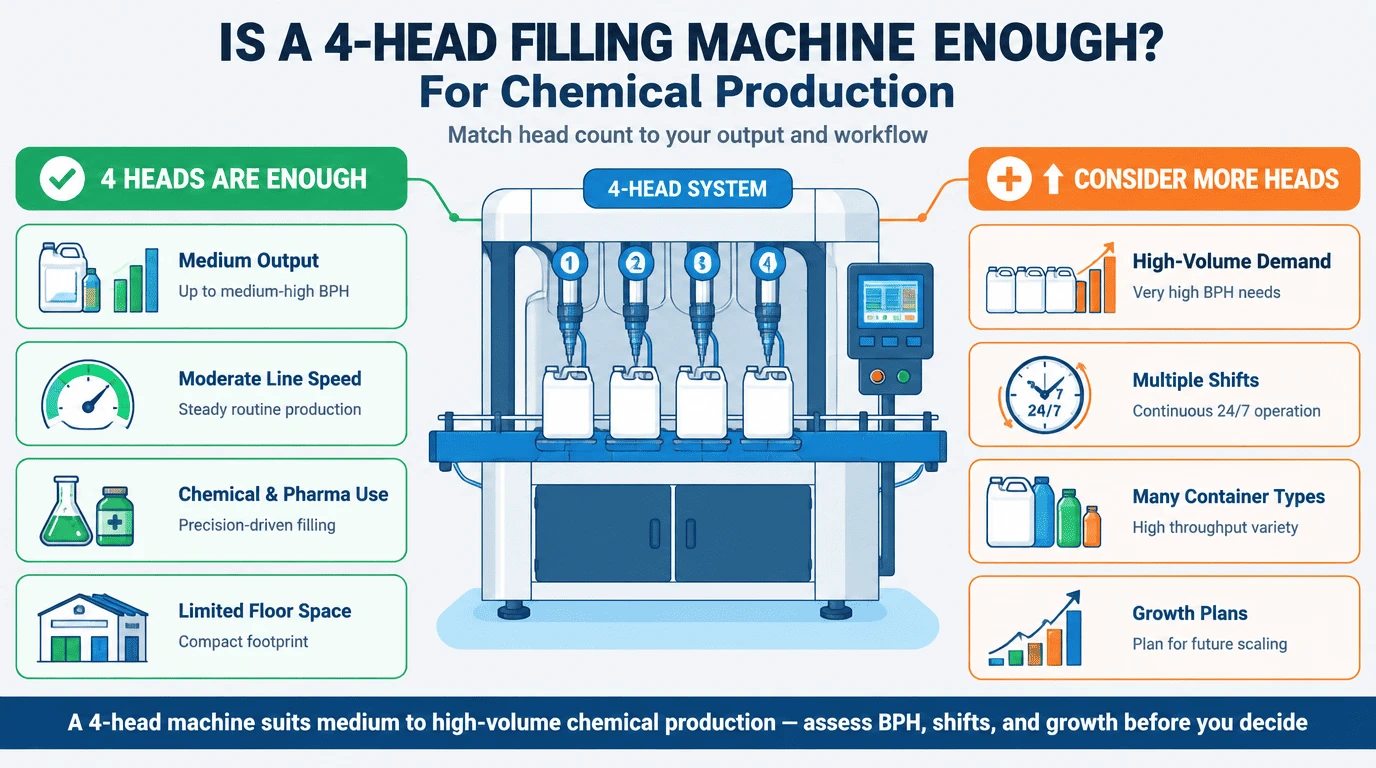
In the chemical industry, corrosive liquid filling is a key process, but the ideal number of filling heads depends on the production requirements and the nature of the corrosive liquids being filled. One of the most common choices is the 4-head anti-corrosion filling machine. But is it enough for chemical production?
In this blog, we provide a comprehensive analysis of 4-head vs multi-head systems, and explain when and why 4-head filling is suitable, and when upgrading to more heads is necessary. We also highlight why Guangzhou RITO Packaging Machinery is the best choice for high-standard anti-corrosion filling solutions.
📖 Table of Contents
Is a 4-Head Filling Machine Enough for Chemical Production?
Evaluating the Sufficient Capacity of a 4-Head Filling System
What Affects the Adequacy of a 4-Head Filling Machine for Chemical Plants?
How Do Fill Head Numbers Impact Chemical Production Efficiency?
Why Is 4-Head Enough or Not Enough in the Chemical Industry?
Why Choose RITO for Your Chemical Production Filling Needs?
RITO's 4-Head and Multi-Head Anti-Corrosion Filling Machines
How to Decide on the Right Number of Filling Heads for Your Chemical Production?
RITO's Experience in Anti-Corrosion Filling Equipment for the Chemical Industry
The Best Way to Meet Production Demands with PP Anti-Corrosion Filling Equipment
1. Is a 4-Head Filling Machine Enough for Chemical Production?
While 4-head anti-corrosion filling machines are commonly used in chemical industries, whether it's enough depends on several key factors:
Production volume (low, medium, or high)
Nature of the chemical (viscosity, corrosiveness, volatility)
Available space and workflow layout
Need for precision, speed, and automation
For small-scale operations or products with moderate production volume, a 4-head system may be sufficient. However, for high-volume chemical production, a system with more filling heads may be needed to increase productivity.
2. Evaluating the Sufficient Capacity of a 4-Head Filling System
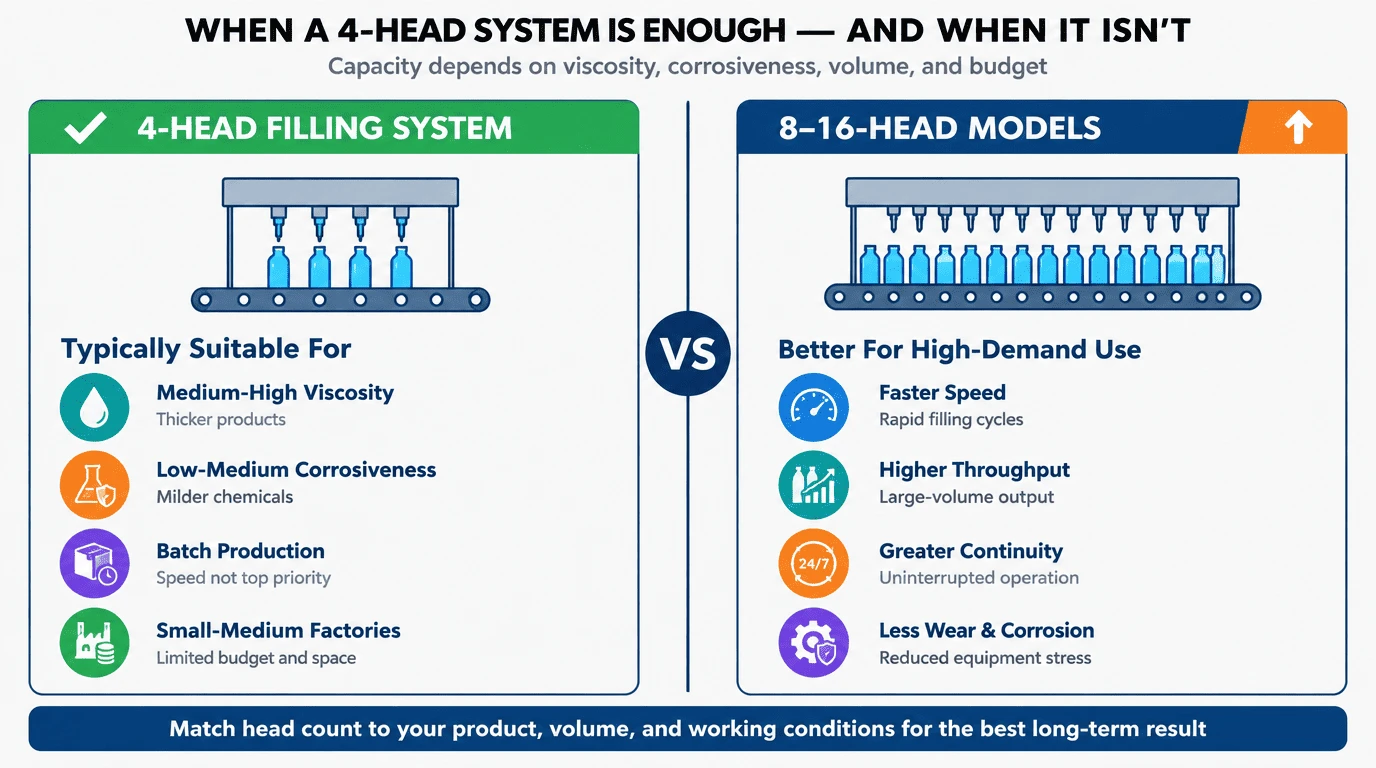
A 4-head filling machine is typically suitable for:
Products with medium to high viscosity
Chemicals with low to medium corrosiveness
Batch production where speed is not the first priority
Small to medium-sized factories with limited budgets and space
For high-speed, large-volume, or highly corrosive liquid products, 8-to-16-head or even multi-head models are more appropriate due to their:
Faster filling speed
Higher throughput
greater operational continuity
reduced risk of equipment wear and corrosion
3. What Affects the Adequacy of a 4-Head Filling Machine for Chemical Plants?
Several factors determine whether a 4-head filling machine is sufficient for your chemical production needs:
| Factor | Impact on Suitability |
|---|---|
| Chemical Viscosity | High viscosity liquids may require more heads for faster filling |
| Corrosivity Level | Highly corrosive materials are better handled by multi-head systems |
| Volume and Frequency | Low-volume, frequent filling can be managed with 4-head systems |
| Automation Level | Semi-automatic options may be sufficient for small-scale use |
| Budget and Space | For production with limited budget or space, 4-head models are more practical |
4. How Do Fill Head Numbers Impact Chemical Production Efficiency?
The number of fill heads directly affects filling speed, accuracy, and overall productivity:
✅ More heads = Higher efficiency
⚠️ Too few heads = Potential bottlenecks
✅ Balanced head count = Optimal cost-performance ratio
For medium to high production volumes, multi-head systems are recommended to ensure smooth operation and minimized downtime.
5. Why Is 4-Head Enough or Not Enough in the Chemical Industry?
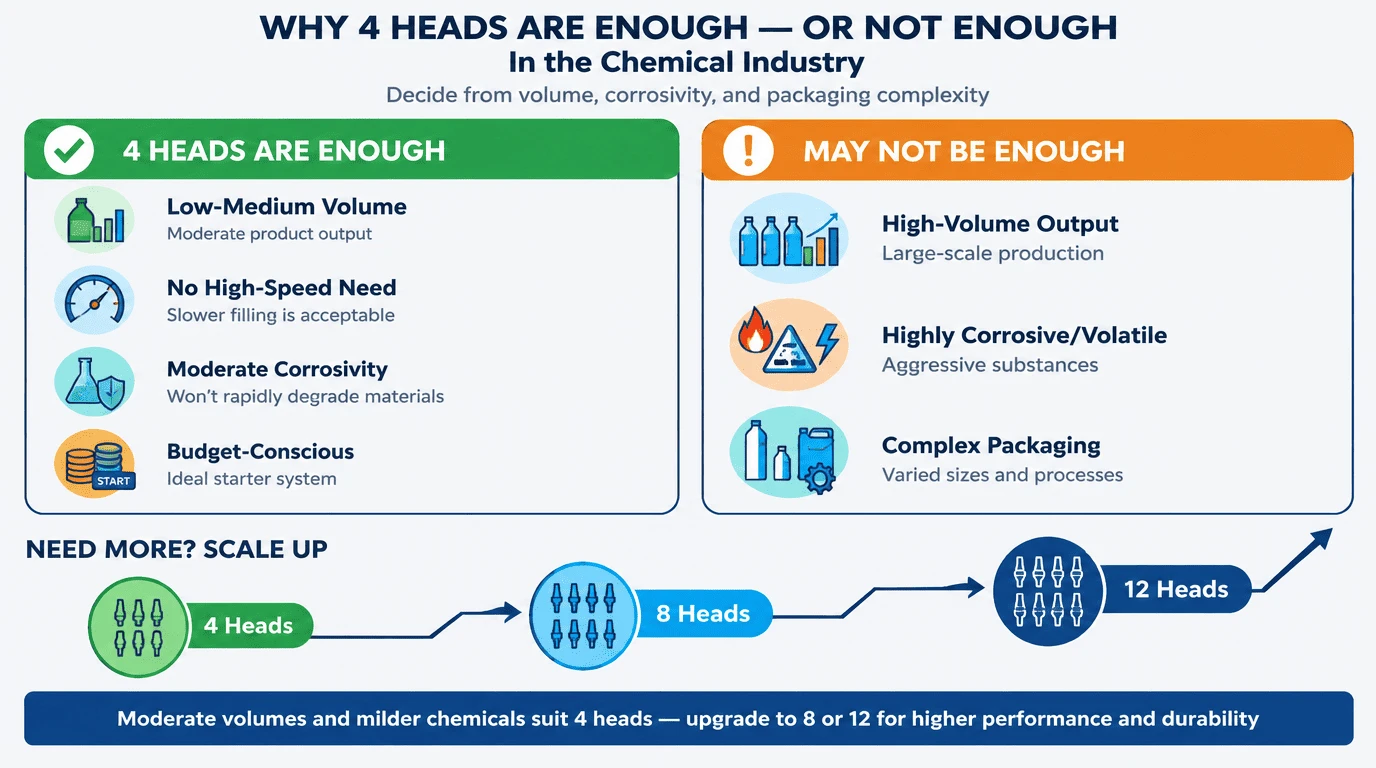
✅ It is Enough for:
Low-to-medium product volume
Items that do not require very high-speed filling
Chemicals with moderate corrosivity that do not severely degrade standard materials
Budget-conscious operations that can benefit from starter systems
❗️ It May Not Be Enough for:
High-volume chemical production
Highly corrosive or volatile substances
Customized, complex packaging needs (e.g., various bottle sizes or special filling processes)
So, if you are working with moderate volumes and less corrosive liquids, a 4-head machine might be sufficient. But if you face higher demands, consider upgrading to 8 or 12 heads for better performance and durability.
6. Why Choose RITO for Your Chemical Production Filling Needs?
As a national high-tech enterprise with over 20 years of R&D experience, Guangzhou RITO Packaging Machinery is uniquely positioned to provide customized anti-corrosion filling solutions tailored to your production needs.
Our 4-head and multi-head filling machines are designed with corrosion-resistant PP material, ensuring:
⭐ High durability and safety
⭐ Precision filling (±1% accuracy)
⭐ Ease of cleaning and maintenance
⭐ Flexible configuration options
⭐ Long-term reliability and cost-effectiveness
Whether you need a 4-head system or more, our experienced team is here to help you choose, install, and operate your machine efficiently and safely.
7. RITO's 4-Head and Multi-Head Anti-Corrosion Filling Machines
We offer a range of filling machines in different head counts:
| Machine Model | Fill Heads | Filling Volume | Production Speed | Application | Features |
|---|---|---|---|---|---|
| RT12 | 12 heads | 500ml–5000ml | 2000–3000 BPH | Medium to large volume | Standard for PLC control, leak-proof design |
| RT16 | 16 heads | 1–2L | 4000 BPH | Large volume, precision required | Fully automated, multiple head options |
| Other Custom Models | 4, 6, 8, 10, etc. | Varied | According to needs | All chemical products | Customized systems, safety in mind |
Each of these models is designed for different chemical applications, ranging from low to high-volume production.
8. How to Decide on the Right Number of Filling Heads for Your Chemical Production?
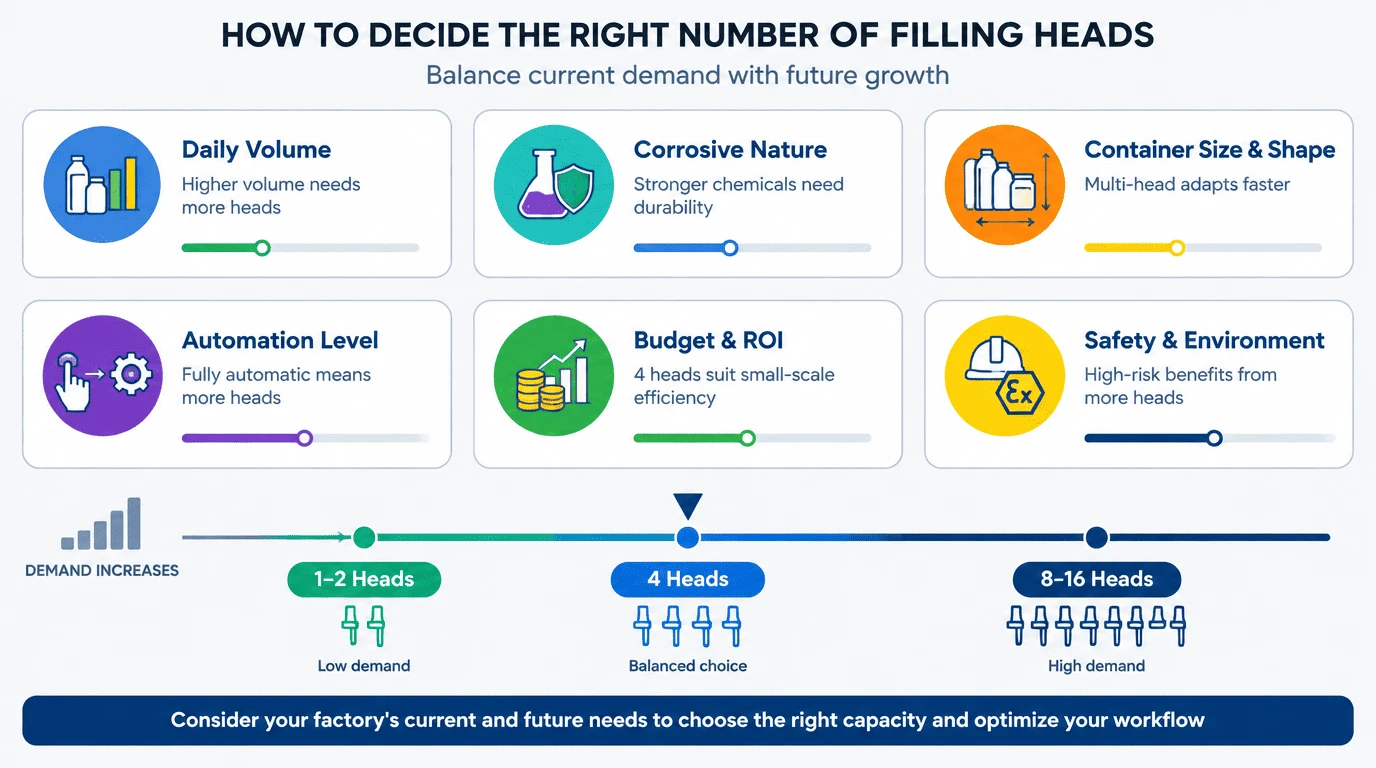
To determine whether 4-head is enough or not, consider the following:
| Consideration | Why It Matters |
|---|---|
| Daily Production Volume | High-volume = need more heads |
| Nature of the Corrosives | Stronger chemicals may need more durability, hence more heads |
| Container Size and Shape | Multi-head systems can adapt faster to various bottle designs |
| Desired Automation Level | Fully automatic = more heads required |
| Budget and ROI (Return on Investment) | 4-head systems provide better cost efficiency for small-scale |
| Environmental and Safety Needs | High-risk situations may benefit from more head configurations |
Consider your factory's current and future needs to choose the right filling capacity and optimize your workflow.
9. RITO's Experience in Anti-Corrosion Filling Equipment for the Chemical Industry
We have over 20 years of experience in packaging solutions for the chemical industry, and have served more than 40 countries and regions worldwide. Our PP-based filling systems are designed to meet the highest standards of performance and safety.
Key reasons for choosing our equipment:
🔧 15 years of industry experience and 20 years of R&D innovation
🧠 Professional engineering team with specialization in corrosion-resistant systems
🌍 Global presence with service centers in the United States, Germany, Vietnam, and more
🛠 Customizable filling systems to suit chemical production needs
📅 Lifetime maintenance and free software upgrades included
Your chemical production needs are unique, and we work with you to design the perfect filling solution.
10. The Best Way to Meet Production Demands with PP Anti-Corrosion Filling Equipment
Using PP material not only ensures strong corrosion resistance, but also improves operational efficiency and reduces maintenance costs. Whether you go for a 4-head or multi-head system, our anti-corrosion PP filling machines offer precision, speed, and long-term reliability.
Our PP-based systems are ideal for processing acids, alkalis, and strong solvents in the chemical and pharmaceutical industries.