
Can the Anti-Corrosion Filling Machine Fill Sodium Hypochlorite (84 Disinfectant)?
📚 Table of Contents
Introduction
What is Sodium Hypochlorite?
Why is Sodium Hypochlorite a Challenge for Filling Machines?
Can the Anti-Corrosion Filling Machine Fill Sodium Hypochlorite?
Why RITO's Anti-Corrosion Filling Machines Are the Best Choice
Key Considerations When Choosing an Anti-Corrosion Filling Machine
Industry Applications of RITO's Anti-Corrosion Machines
The Science Behind RITO's Anti-Corrosion Technology
Frequently Asked Questions (FAQs)
Conclusion
About RITO – A Leader in Anti-Corrosion Filling Solutions
📌 1. Introduction
In the chemical and cleaning industries, sodium hypochlorite, commonly known as 84 disinfectant, is a highly corrosive and reactive liquid used in disinfection, sterilization, and water treatment.
Handling such a dangerous and chemically aggressive liquid requires specialized anti-corrosion filling machines, designed to withstand chemical exposure and prevent degradation.
This article answers the critical question:
Can the anti-corrosion filling machine fill sodium hypochlorite (84 disinfectant)?
And explains why RITO's machines are built to do so safely and efficiently.
📌 2. What is Sodium Hypochlorite?
Sodium hypochlorite (NaOCl) is a strong oxidizing and corrosive chemical, widely used in:
Water treatment and purification
Household and commercial cleaning
Industrial sterilization and disinfection
Pharmaceutical and biomedical applications
It is alkaline (pH ~11–12), highly reactive, and oxidative, posing serious challenges for filling machines that are not chemically compatible.
In this section, we explain its chemical properties and why it's not suitable for standard filling equipment.
📌 3. Why is Sodium Hypochlorite a Challenge for Filling Machines?

Filling sodium hypochlorite can be technically and safety-oriented due to its corrosive and reactive nature.
| Challenge | Description |
|---|---|
| Chemical Corrosion | Standard materials can degrade over time when exposed to NaOCl |
| Reactivity with Metals | Sodium hypochlorite can react with many metals, leading to equipment damage and safety issues |
| Need for Precision | Accurate dosing is crucial for product quality and regulatory compliance |
| High Oxidation Levels | Machines must be resistant to oxidation in pulsed or large-scale operations |
| Cleaning and Maintenance | Residue buildup can cause long-term damage, so easy cleaning is essential |
These challenges highlight the need for specialized anti-corrosion filling machines, such as those developed by RITO, to safely and efficiently handle sodium hypochlorite.
📌 4. Can the Anti-Corrosion Filling Machine Fill Sodium Hypochlorite?
✅ The Answer – Yes!
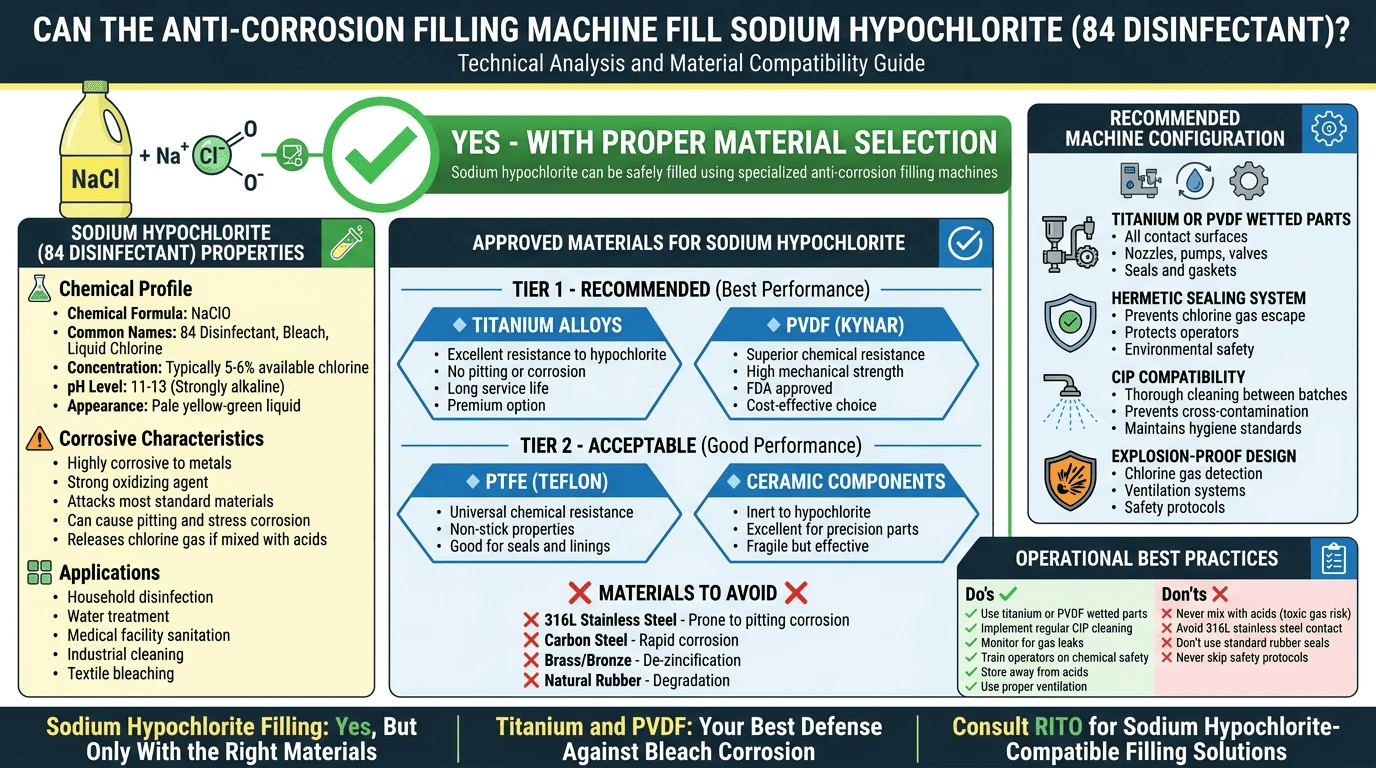
✅ Yes, anti-corrosion filling machines can fill sodium hypochlorite (84 disinfectant) safely and efficiently.
The secret lies in material science and advanced coating technology. RITO's anti-corrosion filling machines are engineered for such corrosive liquids, ensuring no degradation, no chemical reaction, and no safety issues.
This section confirms the feasibility and explains the importance of material and coating in achieving success.
📌 5. Why RITO's Anti-Corrosion Filling Machines Are the Best Choice
There are several reasons why RITO stands out in the sodium hypochlorite filling market:
| Feature | Advantage |
|---|---|
| Advanced Material Selection | Uses 316L stainless steel and chemical-resistant alloys for corrosion resistance |
| Proven Coating Technology | Applies TFE/PTFE coatings for surface protection and cleanability |
| Sealed and Enclosed Design | Ensures chemical exposure is minimized, improving safety and efficiency |
| Adjustable Pressure and Flow Control | Achieves precise, consistent filling even in high-volume and high-corrosion scenarios |
| Customizable for Various Applications | RITO has expertise in tailoring machines to meet the unique needs of your industry |
These features and applications make RITO the ideal choice for filling sodium hypochlorite (84 disinfectant).
📌 6. Key Considerations When Choosing an Anti-Corrosion Filling Machine
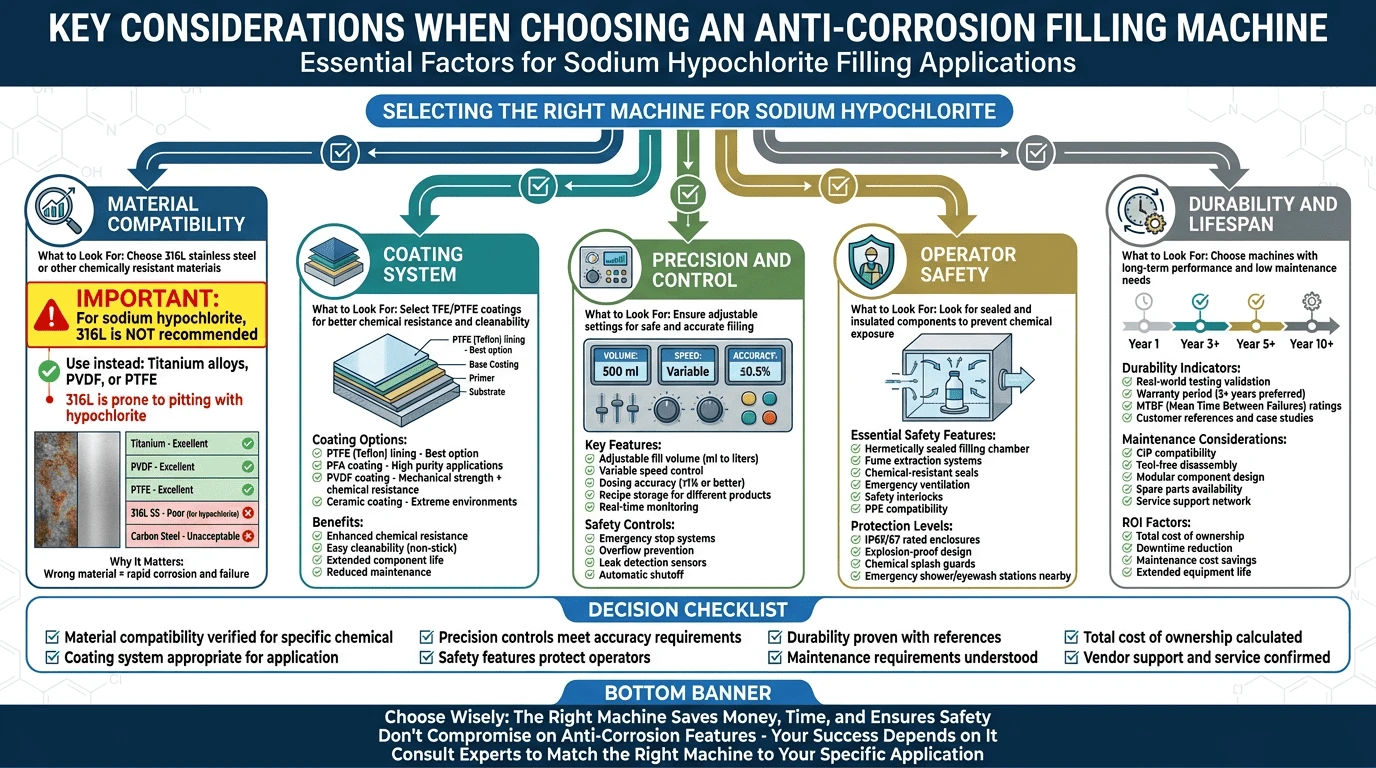
When selecting an anti-corrosion filling machine for sodium hypochlorite, consider:
| Factor | What to Look For |
|---|---|
| Material Compatibility | Choose 316L stainless steel or other chemically resistant materials |
| Coating System | Select TFE/PTFE coatings for better chemical resistance and cleanability |
| Precision and Control | Ensure adjustable settings for safe and accurate filling |
| Operator Safety | Look for sealed and insulated components to prevent chemical exposure |
| Durability and Lifespan | Choose machines with long-term performance and low maintenance needs |
📌 7. Industry Applications of RITO's Anti-Corrosion Machines
Industries That Benefit From RITO's Solutions
| Industry | Application | Why RITO Is a Good Fit |
|---|---|---|
| Water Treatment Plants | Filling large volumes of sodium hypochlorite for disinfection and water purification | Ensures safety, durability, and efficiency in chemical-heavy environments |
| Disinfectant and Cleaning Product Plants | Filling 84 disinfectant, industrial cleaners, and sterilization products | Offers high-performance, safe, and customizable filling solutions |
| Chemical Manufacturing and Storage | Safe handling of corrosive and reagent-based materials | Reduces maintenance, downtime, and chemical waste |
| Pharmaceutical Industry | Filling disinfectants, sterilization agents, and cleaning products | Maintains product integrity and compliance |
| Industrial Sterilization and Sanitization | Supporting cleaning in high-reactive environments | Ensures safe, clean, and consistent chemical handling |
These real-world applications demonstrate how RITO's solutions are trusted and effective.
📌 8. The Science Behind RITO's Anti-Corrosion Technology

RITO's anti-corrosion filling machines are not just a product, they are a solution engineered to handle strong chemical demands.
How We Achieve Anti-Corrosion in Our Machines
| Technology | Purpose | Impact on Sodium Hypochlorite |
|---|---|---|
| 316L Stainless Steel | Provides core corrosion resistance with high durability | Resists oxidation and chemical damage in harsh environments |
| TFE / PTFE Coating | Adds a chemical resistant layer on critical internal surfaces | Enhances cleanability, safety, and long-term performance |
| Enclosed and Insulated Systems | Minimizes chemical and product exposure | Preserves both the machine and the product |
| Compliance with Industrial Standards | Meets GMP, ISO, CE, and chemical safety requirements | Ensures international acceptance and usage |
| R&D and Innovation | Our team of experts with over 20 years of experience drives continuous improvement and reliability | Provides forward-thinking and future-proof solutions |
📌 9. Frequently Asked Questions (FAQs)
Q1: Can an anti-corrosion filling machine fill sodium hypochlorite?
A: Yes! RITO's anti-corrosion filling machines are specifically designed for handling corrosive and reactive liquids like sodium hypochlorite.
They use 316L stainless steel and TFE/PTFE coating to resist corrosion and chemical reactions, ensuring safe and efficient performance.
Q2: How does RITO handle the corrosive nature of 84 disinfectant?
A: RITO uses chemically compatible materials and strategically applied coatings to protect machine components from NaOCl exposure.
This ensures no degradation and no operator exposure, even in high-corrosion environments.
Q3: Are RITO's machines suitable for other corrosive chemicals?
A: Yes. RITO's anti-corrosion filling machines are designed for a variety of strong chemicals, including hydrochloric acid, ammonia, and industrial solvents.
We use materials and coatings that are highly adaptable, ensuring safety and performance in different chemical applications.
Q4: What is the lifespan of RITO's filling machines when used with sodium hypochlorite?
A: Depending on operational conditions, RITO's machines can last up to 10 years with proper maintenance and protection.
Our design and engineering ensure long-term durability and low maintenance needs.
Q5: What are the key benefits of using a RITO anti-corrosion filling machine for 84 disinfectant?
A: The main benefits include:
High chemical resistance to corrosive liquids
Precise and consistent filling for product quality
Long-lasting and reliable performance
Minimal maintenance and downtime
Operator safety and product integrity
Compliance with global standards
📌 10. Conclusion
✅ Final Thoughts
So, Can the anti-corrosion filling machine fill sodium hypochlorite (84 disinfectant)?
Yes. And RITO is the best choice for this application.
With corrosion-resistant materials, advanced coating technology, and customizable systems, RITO ensures safe, efficient, and durable performance even in the harsh conditions of sodium hypochlorite filling.
Whether you're in water treatment, disinfectant production, or industrial cleaning, RITO brings tried-and-tested solutions that meet your core needs.


