What Kind of Filling Machine Can Handle Strong Acid and Strong Alkali Liquids?
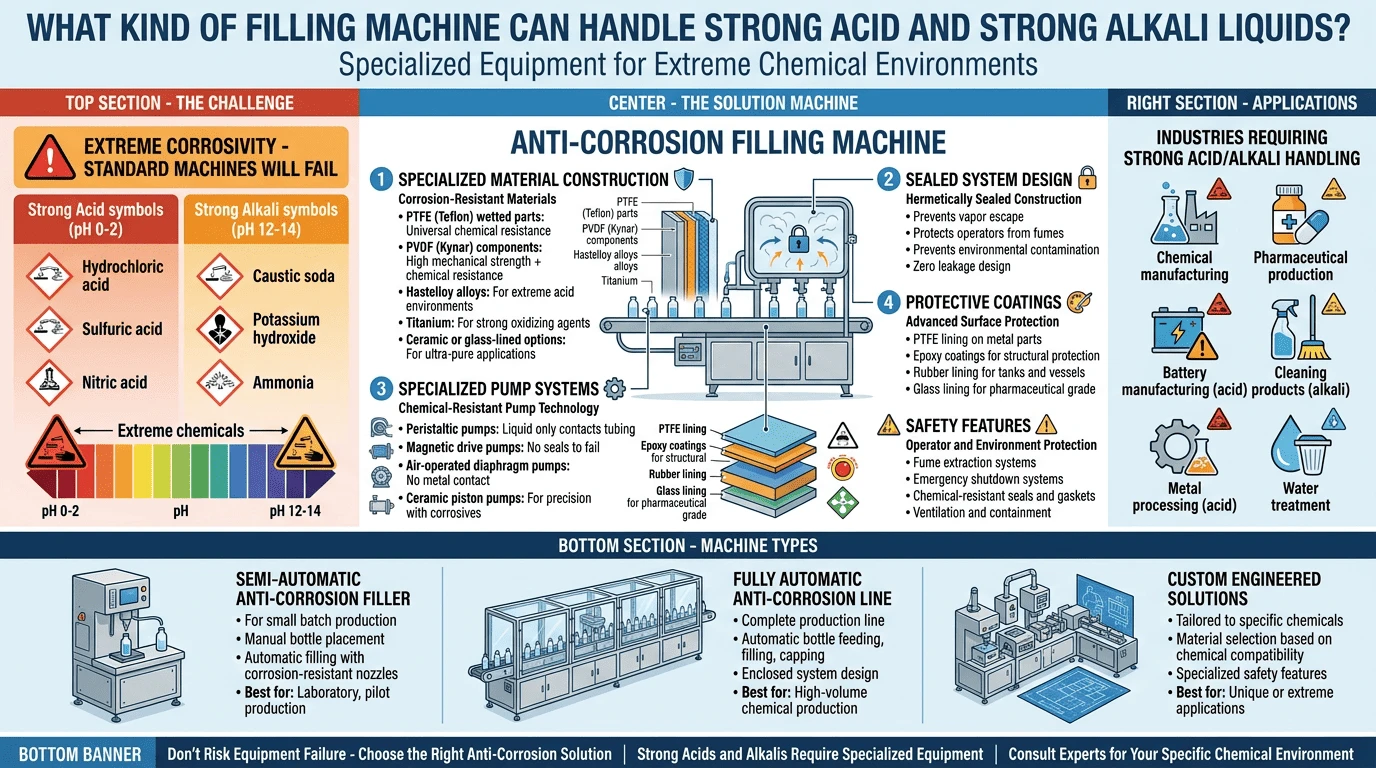
🔍 Your search for a robust and reliable filling machine: The answer is here.
As a manufacturer or business owner in the chemical industry, pharmaceutical sector, or any field that involves handling strong acids and strong alkali liquids, you know how critical it is to choose the right filling machine. These corrosive substances are not just risky to work with-they can also severely degrade standard packaging equipment, leading to safety hazards, frequent maintenance, and cost inefficiencies.
In this blog, we will walk you through everything you need to know about the best filling machines for strong acid and strong alkali applications, including material science, sealing technology, and design choices that ensure long-lasting performance even in the harshest chemical environments.
Table of Contents
Understanding Strong Acid and Strong Alkali Handling Requirements
Why Standard Filling Machines Fall Short
What Kind of Filling Machine Can Handle Strong Acids and Alkalis?
Key Features of Corrosion-Resistant Filling Machines
Materials That Make a Filling Machine Acid- and Alkali-Resistant
How to Choose the Right Filling System for Corrosive Liquids
Best Practices for Using and Maintaining Acid/Alkali-Friendly Filling Machines
Guangzhou RITO's Expertise in Corrosion-Resistant Packaging Solutions
Why RITO Is the Best Choice for Strong Acid and Strong Alkali Handling
Conclusion: Make the Right Investment in Corrosion-Resistant Filling Technology
1. Understanding Strong Acid and Strong Alkali Handling Requirements
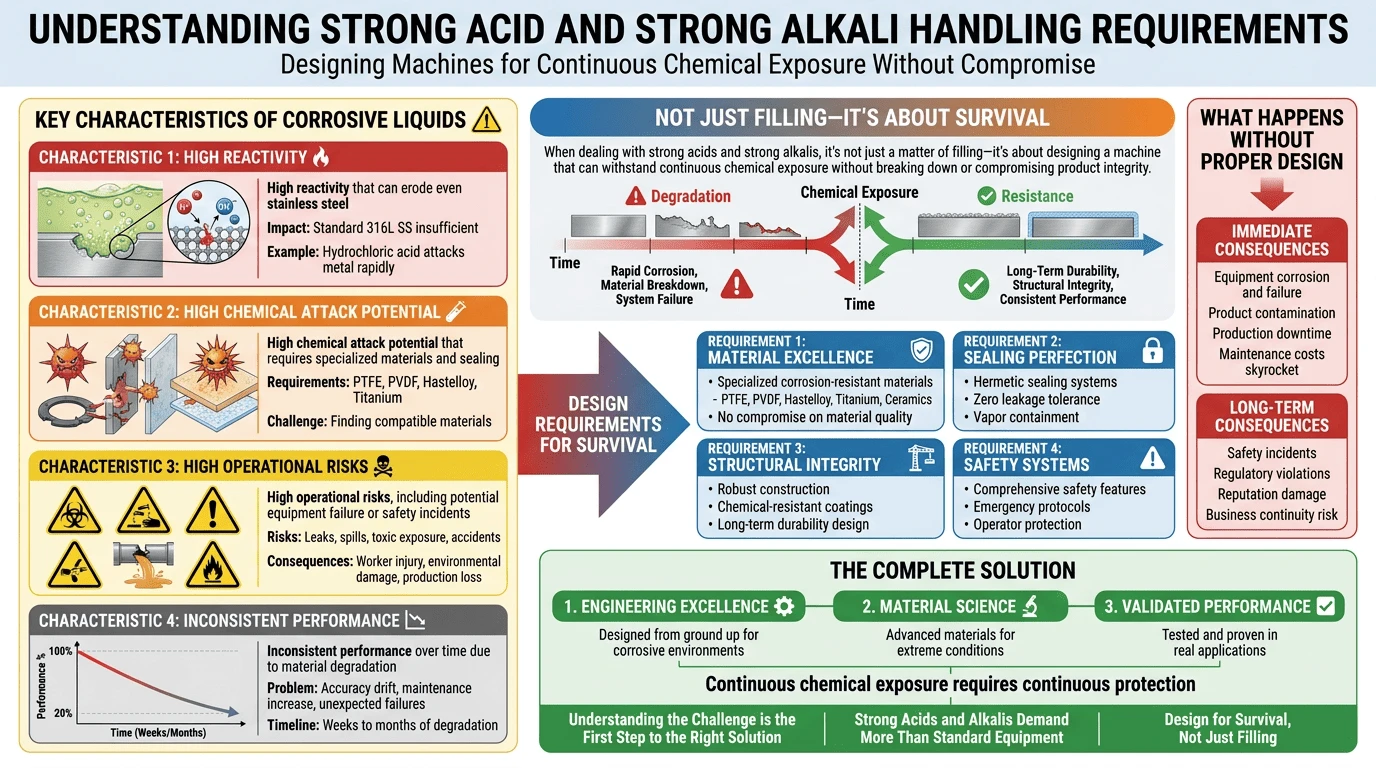
When dealing with strong acids and strong alkalis, it's not just a matter of filling-it's about designing a machine that can withstand continuous chemical exposure without breaking down or compromising product integrity.
These corrosive liquids have the following key characteristics:
High reactivity that can erode even stainless steel
High chemical attack potential that requires specialized materials and sealing
High operational risks, including potential equipment failure or safety incidents
Inconsistent performance over time due to material degradation
So, what kind of filling machine should you look for?
2. Why Standard Filling Machines Fall Short
❌ Standard filling machines are generally not suited for use with strong acids or strong alkalis.
Here's why:
| Issue | Description | Impact |
|---|---|---|
| Material Degradation | Cheap materials like regular stainless steel or plastic can corrode | Increased maintenance and downtime |
| Chemical Leaks & Contamination | Poor seals or exposure points can lead to leaks | Risk of cross-contamination, safety hazards |
| Reduced Precision & Accuracy | Chemical residue can affect electronic and mechanical functions | Compromised product quality and process control |
| Shortened Lifespan | Corrosive environments lead to rapid wear | Higher replacement and repair costs |
| Safety Compliance Risks | Many industries require strict chemical resistance standards | Potential legal or safety violations |
These risks make standard systems impractical for long-term use in strong acid and strong alkali environments.
3. What Kind of Filling Machine Can Handle Strong Acids and Strong Alkalis?
✔️ The answer is clearly corrosion-resistant filling machines, especially those designed specifically for aggressive chemical applications.
Here are the best options for handling strong acid and strong alkali liquids:
| Machine Type | Application | Why It Works |
|---|---|---|
| Piston Fillers | Strong acids, pastes, thick liquids | Minimal direct contact with corrosive components |
| Corrosion-Resistant Filling System | Industrial chemicals, detergents, cleaning agents | Built with chemical inert materials (e.g. 316L Stainless Steel, Teflon Coating) |
| Gasket or Seal-Based Filling Systems | High-precision chemical filling | Safe and leak-free operation |
| Flexible Pump Fillers | Viscous, corrosive, or varying viscosity liquids | Adaptable for a wide range of applications |
| Custom-Designed Chemical Filling Machines | High-purity industrial chemical production | Tailored to meet specific chemical exposure, operational needs, and industry standards |
| Auto Corrosive Filler (ACF) | High-volume, high-corrosion environments | Optimized for long-term durability and maximum safety |
These systems are specifically designed to survive in the most aggressive environments.
4. Key Features of Corrosion-Resistant Filling Machines
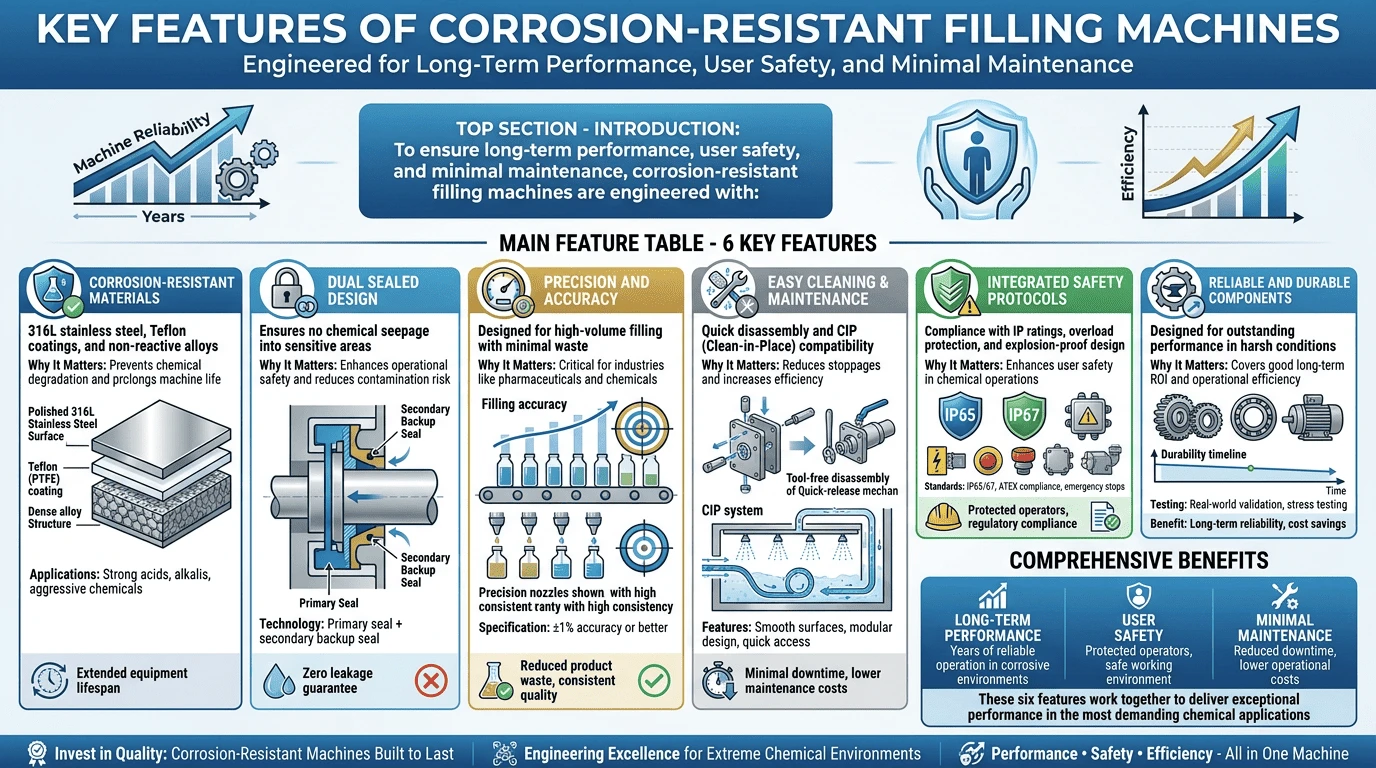
To ensure long-term performance, user safety, and minimal maintenance, corrosion-resistant filling machines are engineered with:
| Feature | Description | Why It Matters |
|---|---|---|
| Corrosion-Resistant Materials | 316L stainless steel, Teflon coatings, and non-reactive alloys | Prevents chemical degradation and prolongs machine life |
| Dual Sealed Design | Ensures no chemical seepage into sensitive areas | Enhances operational safety and reduces contamination risk |
| Precision and Accuracy | Designed for high-volume filling with minimal waste | Critical for industries like pharmaceuticals and chemicals |
| Easy Cleaning & Maintenance | Quick disassembly and CIP (Clean-in-Place) compatibility | Reduces stoppages and increases efficiency |
| Integrated Safety Protocols | Compliance with IP ratings, overload protection, and explosion-proof design | Enhances user safety in chemical operations |
| Reliable and Durable Components | Designed for outstanding performance in harsh conditions | Covers good long-term ROI and operational efficiency |
5. Materials That Make a Filling Machine Acid- and Alkali-Resistant
The foundation of an effective corrosion-resistant filling machine is its materials. Here are the most common materials used in strong acid and strong alkali filling systems:
| Material | Characteristics | Application |
|---|---|---|
| 316L Stainless Steel | Excellent resistance to chemical corrosion | Ideal for high-acid and high-alkali environments |
| PTFE (Polytetrafluoroethylene) | Chemically inert and non-stick | Used to coat key components (e.g. nozzles, seals, and inner parts) |
| Non-Reactive Alloys | Minimizes interaction with reactive substances | Supports brands in the chemical and pharmaceutical industries |
| Chemically Sealed Components | Professional sealing systems that stop chemical exposure | Prevents leakage and accidental cross-contact |
| High-Density Plastics | Environmentally friendly and chemical-resistant | Suited for corrosive environments with weight-saving benefits |
| Specially Treated Surfaces | Prevents chemical buildup and enhances durability | Keeps the machine seamless in long production runs |
These materials are not just about resisting corrosion-they're about long-term performance and safety.
6. How to Choose the Right Filling System for Corrosive Liquids
Choosing the right filling machine for strong acid and strong alkali liquids involves careful assessment of your application. Below are the key selection criteria:
| Criteria | Explanation | Recommended Action |
|---|---|---|
| Type of Product | Whether it's a liquid, paste, or powder | Select a piston, pump, or specialized filling system based on viscosity and corrosivity |
| Container Type | Glass, plastic, or metal containers | Ensure compatibility with nozzle and sealing systems |
| Required Filling Speed | How many bottles per minute/hour | Choose between manual, semi-automatic, and fully automatic based on production volume |
| Chemical Corrosion Resistance | Materials and design that withstand chemical exposure | Use 316L stainless steel or Teflon-lined coating |
| Safety & Compliance | Requirements like GMP, IP ratings, and cleaning standards | Always check for corrosion protection and system safety |
| Budget and ROI | Cost vs. long-term operational savings | Opt for high-quality, high-performance machines with durable construction |
| After-Sales Support | Who will help you when something goes wrong | Choose a provider with proven service support and fast response time |
7. Best Practices for Using and Maintaining Acid/Alkali-Friendly Filling Machines
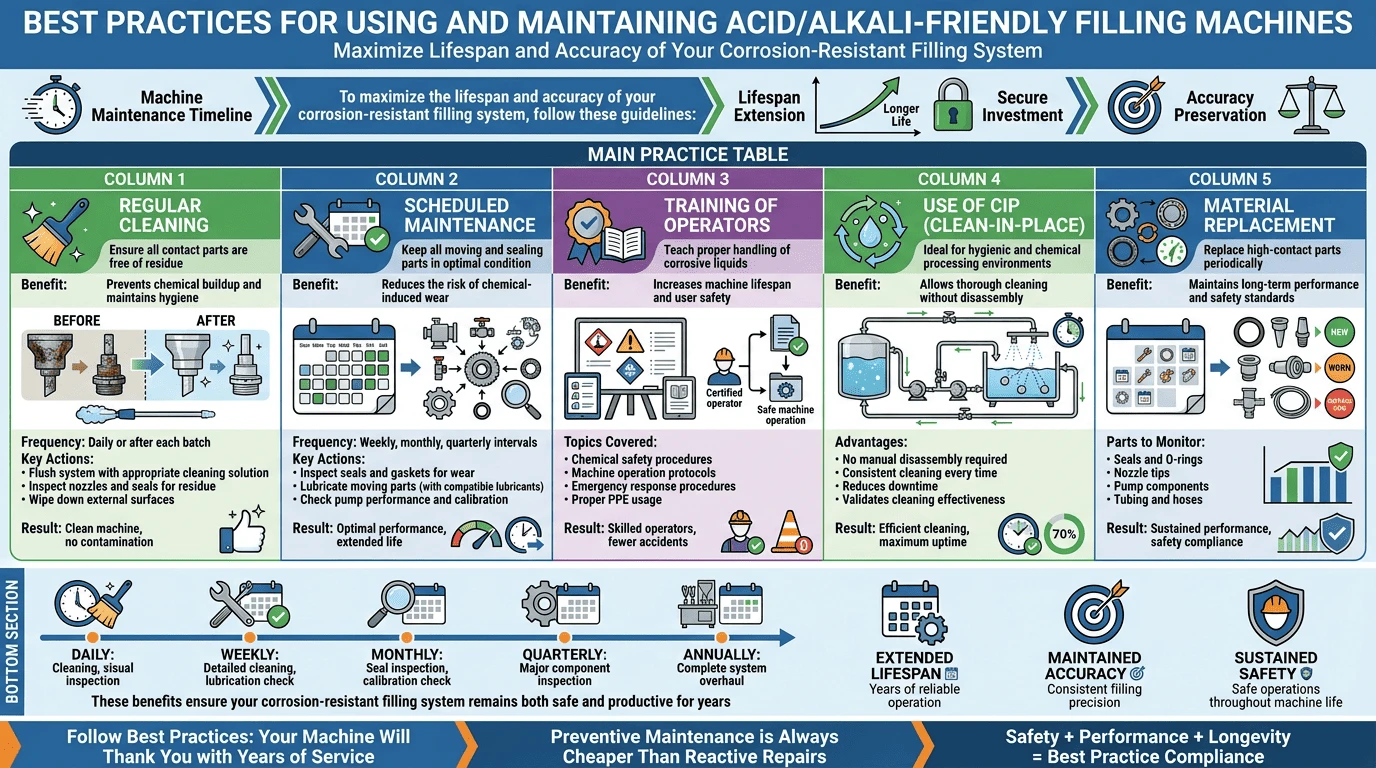
To maximize the lifespan and accuracy of your corrosion-resistant filling system, follow these guidelines:
| Practice | Description | Benefit |
|---|---|---|
| Regular Cleaning | Ensure all contact parts are free of residue | Prevents chemical buildup and maintains hygiene |
| Scheduled Maintenance | Keep all moving and sealing parts in optimal condition | Reduces the risk of chemical-induced wear |
| Training of Operators | Teach proper handling of corrosive liquids | Increases machine lifespan and user safety |
| Use of CIP (Clean-in-Place) | Ideal for hygienic and chemical processing environments | Allows thorough cleaning without disassembly |
| Material Replacement | Replace high-contact parts periodically | Maintains long-term performance and safety standards |
These benefits ensure your corrosion-resistant filling system remains both safe and productive for years.
8. Guangzhou RITO's Expertise in Corrosion-Resistant Packaging Solutions
Since established in 2013, Guangzhou RITO Packaging Machinery Co., Ltd. has been committed to innovation and precision in chemical, pharmaceutical, food, and other industrial sectors.
We are not a generic supplier-we are a **leader in **chemical-resistant packaging technology, with:
✅ 10+ patents, of which over 5 are invention patents
✅ 15 years of industry experience and deep market understanding
✅ 3000㎡ Guangzhou headquarters with advanced R&D facilities and state-of-the-art production
✅ Chinese government-backed high-tech enterprise with proven track record and customer trust
✅ End-to-end services, including pre-sales, after-sales, and installation support
✅ On-site support, including free software upgrades and lifetime maintenance
✅ Custom solutions tailored for industry-specific needs
9. Why RITO Is the Best Choice for Strong Acid and Strong Alkali Handling
At Guangzhou RITO, we understand the demands of handling corrosive substances. That's why we engineer our machines for long-term use in high-corrosion environments, including:
✅ Corrosion-resistant materials like 316L stainless steel and Teflon coatings
✅ Dual-sealed filling systems that minimize chemical leakage
✅ Professional machine design for chemically challenging applications
✅ Hazard-free manufacturing and safety-compliant technology
✅ Industry certifications, material standards, and high-performance design
These features ensure that your filling system is not only safe but also highly efficient for even the most corrosive liquids.
10. Conclusion: Make the Right Investment in Corrosion-Resistant Filling Technology
In summary, the correct filling machine for strong acids and strong alkalis must be designed with corrosion resistance in mind, using 316L stainless steel, sealed internal systems, and user-friendly, safe, and precise technology.
By choosing a specialized filling machine like the Auto Corrosive Filler (ACF) or our custom-designed corrosion-resistant machines, you ensure:
🔧 Long-term machine durability
📌 Accurate and consistent filling
✅ Safe operation in chemical environments
💼 High ROI with low maintenance costs
🧠 Smart, modern, and effective filling solutions