What Are the Materials Used in Filling Machines? A Comprehensive Guide

In the world of packaging and production, the choice of materials in filling machines plays a critical role in performance, safety, and longevity. But is a filling machine fully made of stainless steel? What parts are actually made of stainless steel? And what materials are used in non-contact areas? This article dives into the true composition of filling machines, with a detailed analysis and practical insights.
Table of Contents
[Why the Question "Is a Filling Machine Entirely Made of Stainless Steel?" Matters]
[Understanding the Core Components of a Filling Machine]
[Stainless Steel: The Preferred Material for Product-Contact Parts]
[Other Materials Used in Filling Machines and Their Roles]
[When Stainless Steel Isn't the Best Choice]
[Industry-Specific Material Selection]
[Balancing Cost and Hygiene: The Economic Implications]
[How to Determine the Material Composition of a Filling Machine]
[Stainless Steel in Other Industrial Machinery]
[Guangzhou RITO Packaging Machinery Co., Ltd.: A Trusted Partner in High-Quality Filling Solutions]
1. Why the Question "Is a Filling Machine Entirely Made of Stainless Steel?" Matters
When it comes to filling machines, the material used in their construction raises many questions. One of the most common is "Is a filling machine entirely made of stainless steel?" This is especially relevant in industries such as food, pharmaceuticals, and beverages where hygiene, durability, and compliance are paramount.
However, the answer isn't straightforward. While stainless steel is the go-to material for parts that come into direct contact with the product, not every component of a filling machine is stainless steel. This article will break down the material composition, discuss the reasons behind these choices, and highlight why stainless steel isn't always the whole story.
2. Understanding the Core Components of a Filling Machine
Filling machines are composed of several key parts that perform different functions. Each component has specific performance, durability, and hygiene requirements, which directly influence the material selection. Here are the main parts of a filling machine and their typical materials:
| Component | Function | Common Material | Notes |
|---|---|---|---|
| Product Contact Parts | Direct interaction with the product | Stainless Steel | Must be corrosion-resistant and easy to clean |
| Frame and Structural Parts | Supports machine structure and ensures stability | Stainless Steel / Aluminum | Combines strength and lightweight design |
| Piping and Valves | Transport and control of liquids | Stainless Steel / PVC / PP / Teflon | Some applications may use alternatives for cost or performance |
| Control Cabinet | Houses electrical and control systems | Stainless Steel / Aluminum | Often uses aluminum for cost and weight reduction |
| Seals and Gaskets | Prevent leaks and maintain pressure | Rubber / Silicone / PVC | Not in direct contact with the product |
| External Covers and Panels | Aesthetic and protection | Acrylic / Plastic / Galvanized Steel | Non-critical for hygiene but enhance user experience |
These materials are selected carefully to achieve a balance between cost, durability, and hygiene standards, which is especially important when placed on the cutting edge of modern packaging automation.
3. Stainless Steel: The Preferred Material for Product-Contact Parts

Stainless steel is widely used in filling machines due to several advantages:
Corrosion Resistance: Stainless steel resists chemical reactions and deterioration, making it ideal for environments where liquids or chemicals are involved.
Hygienic Surface: Its smooth, non-porous surface prevents bacterial growth and adheres to GMP (Good Manufacturing Practice) standards required in food and pharmaceutical industries.
Easy to Clean and Sanitize: Unlike other materials, stainless steel can be easily wiped, disinfected, and maintained to the highest standards.
For food and beverage applications, such as bottle filling machines, 304 or 316 stainless steel is the go-to choice to ensure safety, longevity, and efficiency.
4. Other Materials Used in Filling Machines and Their Roles
While stainless steel dominates the critical parts of filling machines, other materials are also used to reduce costs and improve operational performance. These include:
1.Aluminum:
Used for frames and casings due to its lightweight and cost-effective nature.
2.Plastic (PVC, PP):
Often used in non-critical areas like piping and seals.
3.Rubber and Silicone:
Commonly found in seals and gaskets, helping reduce noise and maintain pressure.
4.Glass Fiber Reinforced Plastic (GRP):
Sometimes used in external casings to enhance aesthetic appeal and structural support without the need for full stainless steel.
| Material Type | Uses | Benefits | Drawbacks |
|---|---|---|---|
| Stainless Steel | Product contact parts, structural components | Durable, hygienic, easy to clean | Higher cost |
| Aluminum | Frame, control cabinet, non-contact parts | Lightweight, cost-effective | Less corrosion-resistant than stainless steel |
| Plastic (PP/PVC) | Pipes, seals, external panels | Inexpensive, non-reactive | Not as durable or hygienic |
| Rubber/Silicone | Seals, gaskets | Anti-leak, noise reduction | Not suitable for high-temperature or acidic environments |
These alternative materials are used in non-critical areas, ensuring cost savings without compromising product safety.
5. When Is Stainless Steel Not the Best Choice for a Filling Machine?

Although stainless steel is the gold standard for products that come into direct contact, there are situations where stainless steel might not be the best option:
High Corrosion Risk:
Some industries deal with strongly corrosive liquids (e.g., chemical or pharmaceutical solutions), and using non-stainless materials like PP or PTFE could be better.
Cost Constraints:
Full stainless steel construction is expensive, and for small to medium-sized businesses, a cost-effective design with selective stainless steel use is more practical.
Design and Structural Requirements:
In some non-hygiene critical areas (like the frame or control panel), aluminum or plastic is used to improve efficiency and reduce weight.
Specialized Applications:
In high-speed lines or chemical handling systems, specialized alloys might be used instead of standard 304 stainless steel for greater resistance to wear and tear.
In these cases, a partially stainless steel design offers a cost-effective and performance-driven solution.
6. Industry-Specific Material Selection
The material choice for a filling machine varies widely depending on the industrial application. Here's a breakdown by industry:
| Industry | Common Materials | Reasons for Use | Compliant Standards |
|---|---|---|---|
| Food and Beverage | 304/316 Stainless Steel | Ensures safety and hygiene | GMP, HACCP |
| Pharmaceuticals | 316 Stainless Steel | Safeguarding against contamination | ISO, FDA |
| Cosmetics and Oils | 304 Stainless Steel | Heat and chemical resistant | ASTM, ISO |
| Chemicals and Solvents | PP, PVC, Teflon | Non-reactive, corrosion-resistant | Industrial safety standards |
| General Industrial Use | 304 Stainless Steel, Aluminum, Plastic | Balances cost and durability | No specific hygiene standard |
This material selection strategy ensures that filling machines meet the needs of their specific industry, while maintaining safety, efficiency, and cost-effectiveness.
7. Balancing Cost and Hygiene: The Economic Implications
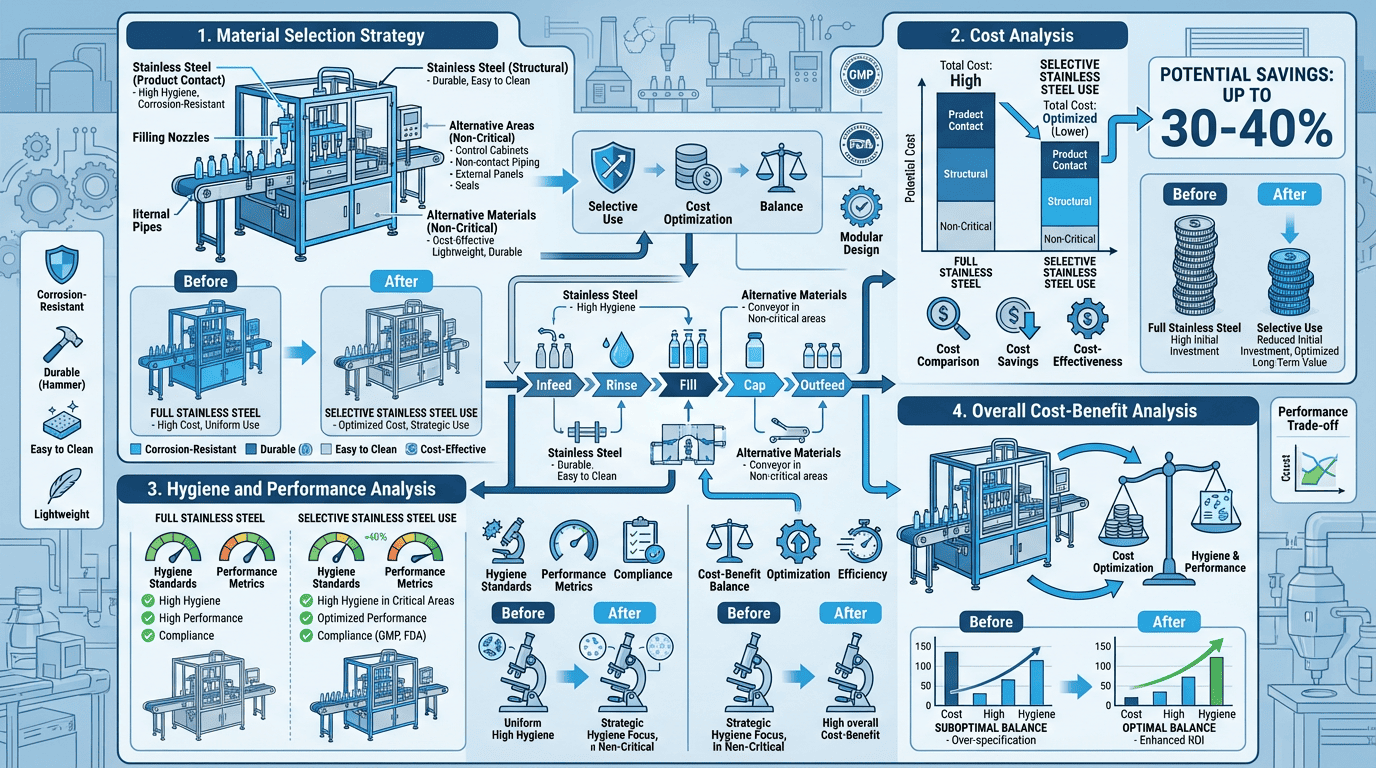
Using stainless steel for an entire filling machine is not always the best financial decision. While stainless steel is corrosion-resistant, durable, and easy to clean, it also increases costs.
For most small and mid-sized businesses, the cost-effective approach is to use stainless steel in product contact areas and structural components, while employing alternative materials in non-critical zones like:
Control cabinets
Non-contact piping
External panels
| Area of Use | Cost | Durability | Ease of Cleanliness |
|---|---|---|---|
| Product Contact Parts | High | High | High |
| Frame and Structural Parts | Medium | High | Medium |
| Piping and Valves | Medium to High | High | High |
| Control Cabinet & Panels | Low | Medium | Low |
| Seals and Gaskets | Low | Medium | Low |
This strategic material choice allows manufacturers to achieve compliance without sacrificing affordability.
8. How to Determine the Material Composition of a Filling Machine
If you're considering a filling machine for your business, here's how to identify the materials used by the manufacturer:
Steps to Identify Material Composition:
1.Consult Specifications:
Review the product manuals or technical specifications. These often list the materials used in each component.
2.Inspect the Machine:
Look for sleek, polished surfaces in product-contact zones - these are often stainless steel.
Check for lighter, less polished materials up high or in non-contact areas.
3.Ask the Manufacturer:
Companies like Guangzhou RITO Packaging Machinery Co., Ltd. are happy to provide you with detailed material composition reports.
Uncertainty about materials can lead to misplaced expectations, so it's always best to verify with the manufacturer before purchase.
9. Stainless Steel in Other Industrial Machinery
Stainless steel is not just used in filling machines - it's a popular material across many industries.
Why Stainless Steel Matters Beyond Filling Machines:
- Food Processing Equipment: Used in packing machines, conveyor systems, and cooking equipment.
- Pharmaceutical Machinery: Found in vial filling machines, capsule filling systems, and sterilization units.
- Medical Devices: From surgical tools to lab equipment, stainless steel offers high durability and hygiene.
- Chemical and Petroleum Equipment: Resists high temperatures and corrosive materials in reservoirs, pumps, and pipes.
The versatility and reliability of stainless steel make it a cornerstone of industrial machinery design.
10. Guangzhou RITO Packaging Machinery Co., Ltd.: A Trusted Partner in Quality Filling Solutions
While this article explores material choices, Guangzhou RITO Packaging Machinery Co., Ltd. specializes in high-quality, customizable filling machines that prioritize both performance and cost-effectiveness.

Why Choose Guangzhou RITO?
1.Advanced R&D:
With over 15 years of experience and a world-class team of mechanical, software, and electrical engineers, our packaging solutions are at the forefront of industry innovation.
2.Multiple Patents:
We have developed more than 10 patents, with over half being invention patents, ensuring technological leadership and product exclusivity.
Customizable Solutions: Based on industry-specific needs, we offer tailored filling machines from piston filling machines to labeling systems and back-end packaging machines.
3.Lifetime Support:
Beyond the warranty period, we offer lifetime maintenance and free software updates, ensuring ongoing value for your investment.
Global Presence: Our products are sold in over 40 countries and regions, including China, the US, Germany, Mexico, Canada, Australia, and more.
At Guangzhou RITO, we understand that no single material is suitable for all applications, and our engineers and product specialists work with you to choose the right materials for your filling needs.
Conclusion
Filling machines are not entirely made of stainless steel, but stainless steel is the dominant material for product-contact parts, frames, and components that support hygiene compliance. Factors like corrosion resistance, cost, and specific industry needs determine material choices.
For industries like food and pharmaceuticals, full stainless steel construction is recommended and required to maintain hygiene and quality standards. However, in other sectors, a mixed material approach offers a cost-effective balance.
At Guangzhou RITO Packaging Machinery Co., Ltd., we provide customized, high-quality filling machines tailored to your specific production requirements. Whether you're working with potable liquids, pharmaceuticals, or chemical products, our professional engineering team ensures optimal material selection for efficiency, safety, and cost control.
FAQs
Q: Are all parts of the filling machine made of stainless steel?
A: This depends on the customer's requirements. For ordinary liquid filling, most parts are made of stainless steel. However, if the product is corrosive, anti-corrosion materials such as PP, PVC, or Teflon are required.
Q: Why are filling machines made of stainless steel?
A: Stainless steel offers excellent corrosion resistance, a smooth surface, and easy cleaning. These characteristics are essential for industries with high hygiene requirements.
Q: Can I purchase a fully stainless steel filling machine from Guangzhou RITO?
A: Yes, of course. Our machines support customization. If your application requires high hygiene standards and durability (such as pharmaceutical or food production lines), a fully stainless steel structure can be customized.
Q: What are the cost advantages of using stainless steel only in certain areas?
A: Selective use of stainless steel in key areas (such as product-contact parts and the machine frame) can help reduce material costs and maintenance expenses.