🧪 How to Ensure Hygiene and Safety When Filling Corrosive Solutions?
An Expert Guide for Industry Professionals and Equipment Operators
📚 Table of Contents
[Understanding the Risks of Corrosive Solutions in Filling Lines]
[Key Factors in Selecting the Right Corrosion-Resistant Filling Machine]
[Maintaining Hygiene and Safety in Corrosive Liquid Filling Machinery]
[Best Practices for Handling Corrosive Liquids in Filling Operations]
[How to Achieve 100% Hygiene and Safety in Corrosive Solution Filling]
[The Role of RITO in Delivering Safe and Hygienic Filling Solutions]
[Conclusion: Prioritize Safety and Hygiene with the Right Filling System]
🧠 1. Understanding the Risks of Corrosive Solutions in Filling Lines
Corrosive solutions, such as acids, alkalis, and industrial solvents, are commonly used in various industries including pharmaceuticals, food processing, chemical manufacturing, and cleaning products. However, due to their aggressive chemical properties, these liquids can pose serious risks to both equipment performance and human safety.
🔍 Risks to Consider:
Equipment Corrosion: Can damage internal components and reduce lifespan.
Chemical Contamination:Contamination may cause products to become non-compliant and may even endanger consumer health.
Personal Injury: Direct contact can cause skin burns, eye damage, or inhalation hazards.
Environmental Impact: Harmful fumes or leaks can pose risks to the surrounding workspace and ecosystems.
These risks make hygiene and safety during the filling process non-negotiable, especially when handling large volumes or high-purity products.
🛠️ 2. Key Factors in Selecting the Right Corrosion-Resistant Filling Machine
When dealing with corrosive solutions, the material selection and machine design play a crucial role in ensuring both hygiene and Safety.
✅ 2.1 Material Selection for Corrosion Resistance
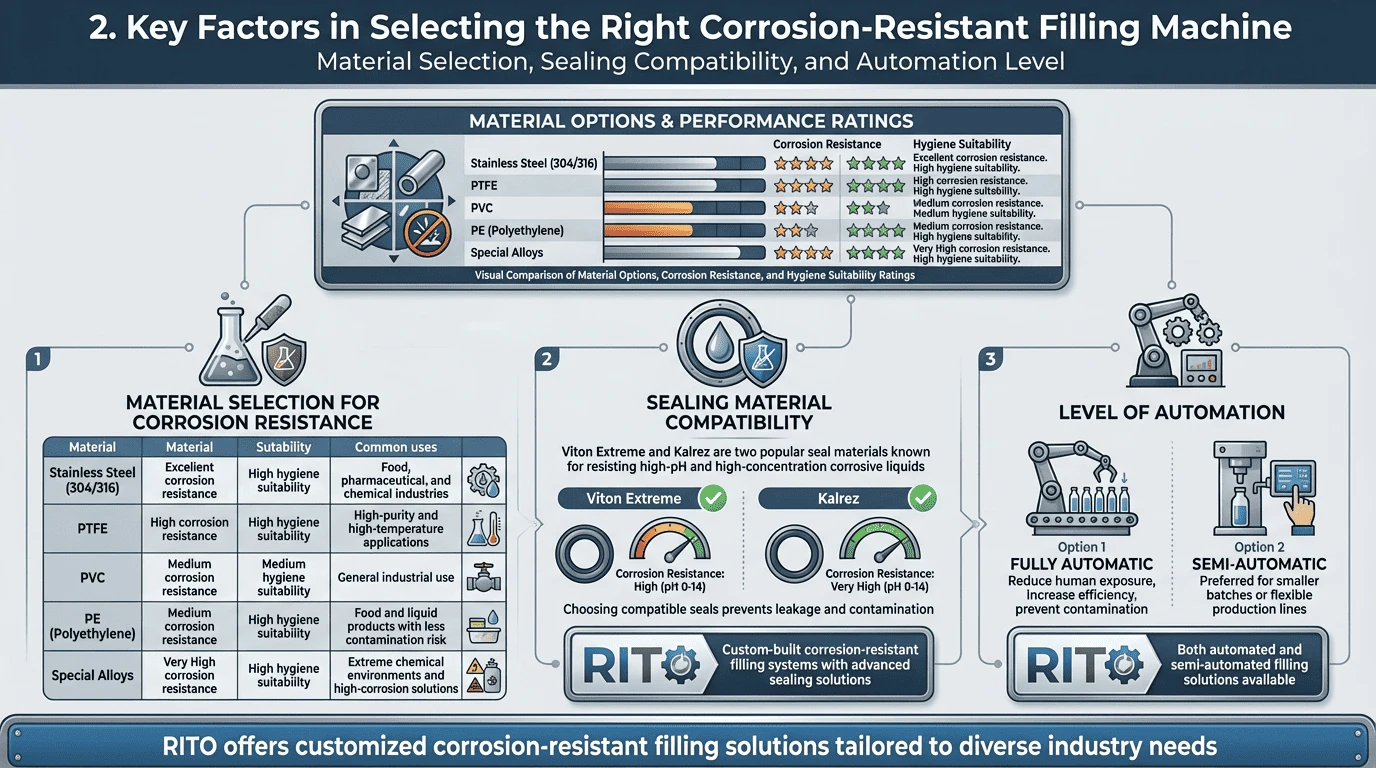
| Material | Corrosion Resistance | Hygiene Suitability | Common Uses |
|---|---|---|---|
| Stainless Steel (304/316) | Excellent | High | Food, pharmaceutical, and chemical industries |
| PTFE | High | High | High-purity and high-temperature applications |
| PVC | Medium | Medium | General industrial use |
| PE (Polyethylene) | Medium | High | Food and liquid products with less contamination risk |
| Special Alloys | Very High | High | Extreme chemical environments and high-corrosion solutions |
✅ 2.2 Sealing Material Compatibility
Viton Extreme and Kalrez are two popular seal materials known for resisting high-pH and high-concentration corrosive liquids.
Choosing compatible seals prevents leakage and contamination.
RITO's custom-built corrosion-resistant filling systems integrate advanced sealing solutions tailored for specific chemical properties.
✅ 2.3 Level of Automation
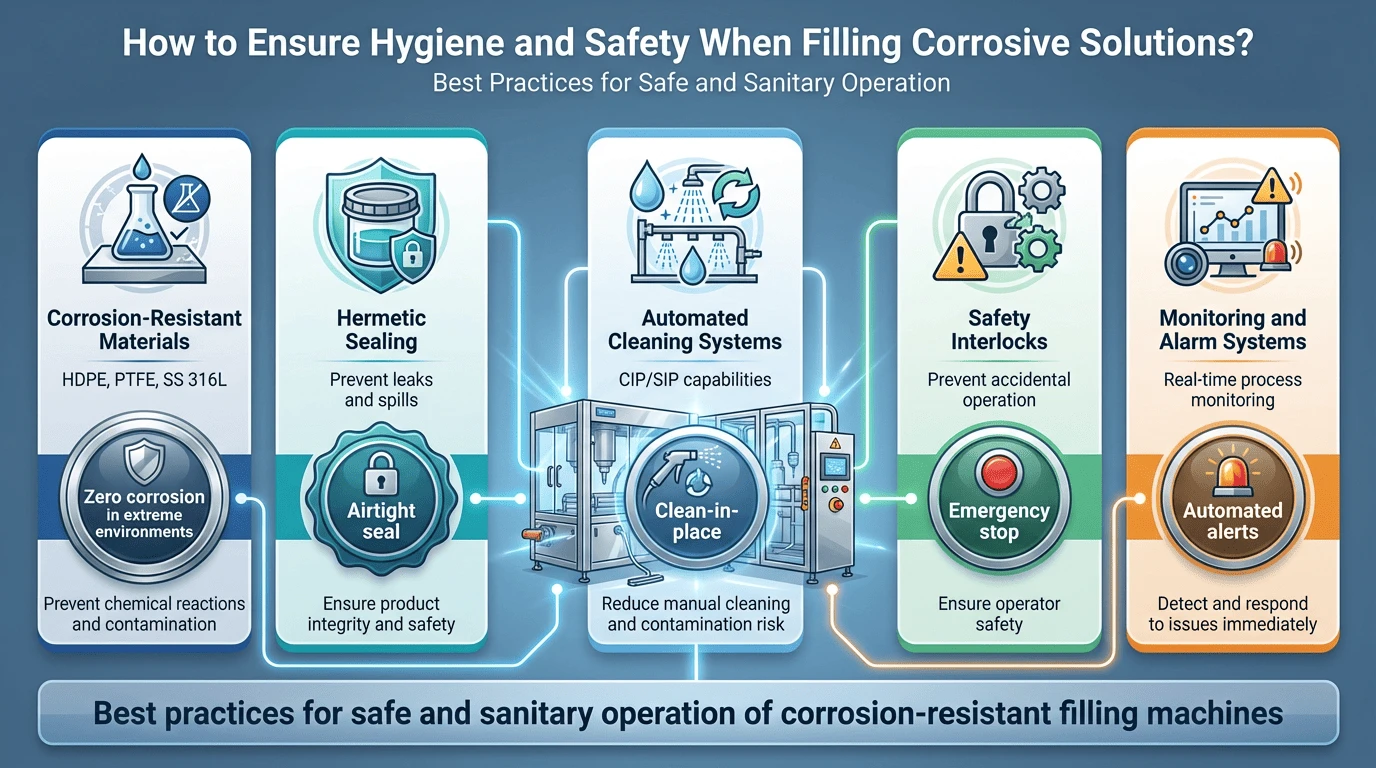
Fully Automatic Filling Machines reduce human exposure, increase efficiency, and prevent contamination.
Semi-Automatic machines are often preferred for smaller batches or flexible production lines.
RITO offers both automated and semi-automated filling solutions to meet diverse industry needs.
🧼 3. Maintaining Hygiene and Safety in Corrosive Liquid Filling Machinery
Proper maintenance and operation are essential to keep your filling machinery safe, hygienic, and efficient over time.
🧼 3.1 Regular Cleaning and Disinfection Protocols
Periodic cleaning is vital to remove chemical residues that may lead to cross-contamination or corrosion.
Recommendation:
Use non-corrosive, food-grade cleaning agents for daily cleaning.
Schedule deep cleaning cycles after each batch to ensure no leftover chemicals remain.
RITO's filling machines are designed for easy disassembly and thorough sanitization.
🔧 3.2 Seal System Checks
Before every filling session, inspect gaskets, valves, and hoses for wear or damage.
A leak-free system is key to product integrity and operator safety.
🔧 3.3 Corrosion Coating Maintenance
For machines with special coatings or linings, regularly check for peeling or cracking.
RITO's Anti-Corrosive Filling Machine are equipped with long-lasting PTFE coatings that minimize chemical contact with metal parts.
👨💻 4. Best Practices for Handling Corrosive Liquids in Filling Operations
Handling corrosive solutions requires a systematic approach to ensure safety, hygiene, and operator well-being.

🛡️ 4.1 Personal Protective Equipment (PPE)
Chemical-resistant gloves (nitrile, neoprene)
Safety goggles and face shields
Protective clothing (lab coats, aprons, boots)
Ventilation masks in high-risk areas
At RITO, we recommend comprehensive PPE training for all operators to reduce exposure risks.
🧼 4.2 Spill Management and Containment
Use spill-proof containers and secondary containment trays.
Immediately clean spills with neutralizing agents and safety protocols.
RITO's corrosion-resistant filling systems are designed to minimize spillage and contain leaks effectively.
🔌 4.3 Proper Ventilation and Air Quality Control
Workspaces should be well-ventilated, especially when dealing with volatile or toxic fumes.
Install fume extraction systems and air filtration units to prevent airborne contamination.
RITO's filling machines are available with built-in ventilation systems to ensure safe working conditions.
🧠 4.4 Training and Standardized Operating Procedures (SOPs)
Operators should understand the properties of the solution being filled.
Standard operating procedures (SOPs) help minimize human error and increase process control.
As a trusted manufacturer, RITO provides detailed training support and operational guides for all our equipment.
🔋 5. How to Achieve 100% Hygiene and Safety in Corrosive Solution Filling
Achieving top-level hygiene and safety in the filling of corrosive solutions is a multi-faceted process, requiring advanced equipment, strict procedures, and constant monitoring.
5.1 Smart and Automated Filling Systems
Modern corrosion-resistant filling machines are equipped with sensors, pressure control, and real-time monitoring systems, ensuring precision and safety in every batch.
Features:
Automatic flow control and level sensing
Non-contact hygiene monitoring and data logging
Multi-stage filling process to prevent cross-contamination
5.2 Integration of Cleanroom Technology
For industries like pharmaceuticals and foods, RITO offers cleanroom-grade filling systems that not only resist corrosion but also maintain sterility and eliminate microbial contamination.
5.3 Customization for Industry-Specific Needs
RITO's corrosion-resistant filling machines can be customized to suit different types of solutions, concentration levels, and operational environments.
Our machines can be adapted for high-purity, high-volume, or hazardous material filling.
🏭 6. The Role of RITO in Delivering Safe and Hygienic Filling Solutions
As the leading manufacturer of corrosion-resistance packing solutions, RITO offers a complete portfolio of high-quality, safe, and hygienic filling machines.

Why Choose RITO for Corrosion-Resistant Filling?
- 10+ invention patents in the field of packaging machinery
- Professional R&D team with over 20 years of experience
- Customized solutions based on industry-specific requirements (e.g., food, pharma, chemicals)
- Designed for easy cleaning and decontamination
- Integrated safety features: explosion-proof, anti-static, and overpressure protection
- Advanced monitoring and control systems for real-time safety and product consistency
- Global Reach: RITO's expertise has been recognized by clients in 40+ countries and regions, including China, the USA, Germany, Vietnam, and more
🧩 7. Conclusion: Prioritize Safety and Hygiene with the Right Filling System
Ensuring hygiene and safety during the filling of corrosive solutions is a critical process in many industries.
Choosing the right filling machine-one that is corrosion-resistant, hygienically designed, and equipped with safety mechanisms-is the first step to achieving a safe and efficient operation.
At Guangzhou RITO Packaging Machinery Co., Ltd., we understand the complexity and risks involved in filling corrosive liquids. That's why we design and manufacture machines that exceed industry standards in terms of safety, hygiene, and performance.
Whether you need automated, semi-automated, or customized filling solutions, RITO is here to help you achieve efficiency, safety, and compliance in your operations.
💬 Frequently Asked Questions (FAQ)
Q: What types of corrosive liquids can RITO's filling machines handle?
A: RITO's machines are suitable for acids, alkalis, solvents, and high-purity liquids, all of which are commonly used in industrial and food/pharmaceutical applications.
Q: Do your machines support cleanroom operations?
A: Yes. RITO provides cleanroom-grade filling systems with sterile environments, precision control, and high-grade sealing to ensure product purity and safety.
Q: How do your machines ensure safety during the filling process?
A: RITO's machines are equipped with safety valves, pressure sensors, anti-static systems, and explosion-proof design for hazardous and volatile solutions.